A long-haul driver pulls into a rest stop after six hours on the highway. He opens his phone, completes a three-minute video on hazardous material handling, answers two quick questions, and grabs a coffee. No laptop required. No endless slide decks. This is modern logistics training.
Training a Mobile, Shift-Based, Deskless Workforce
Logistics runs on strict timelines. Fleet managers and warehouse directors cannot easily halt operations for day-long training sessions. Your workforce is on the road, operating forklifts, or working night shifts across distributed depots.
Why 45-Minute Desktop LMS Modules Fail
Deskless workers do not sit at office computers. Forcing a truck driver or courier to complete a 45-minute desktop course during off-hours leads to frustration. Retention drops when fatigue sets in. Traditional learning simply does not fit shift work.
The Cost of Driver Churn, Safety Incidents, and Missing Compliance Checks
High turnover creates substantial operational costs. According to the IRU's updated survey data, unfilled truck driver positions in Europe reached approximately 502,000 (a 13% shortage rate). Meanwhile, data from the American Trucking Associations (ATA)—frequently analysed in retention studies by institutions such as the University of Arkansas—indicates that annual turnover in large long-haul truckload carriers routinely fluctuates between 70% and 90%.
Replacing a single commercial driver costs carriers anywhere from $8,000 to $15,000 (~£6,100 to £11,500), depending on how fleets account for recruitment, onboarding administrative costs, and equipment downtime. Inefficient, non-standardised onboarding programmes can amplify these costs by prolonging ramp-up time and increasing early driver attrition.
Weak Signal, High Stakes: Overcoming Connectivity Barriers in Freight and Warehousing
Long-distance drivers travel through areas with limited cellular service. Concrete and steel warehouse buildings often block mobile network signals. Training tools must work reliably regardless of internet connectivity.
The 3-Pillar Microlearning Framework for Supply Chain Enablement
To fix workforce training friction, supply chain leaders are adopting mobile microlearning frameworks.
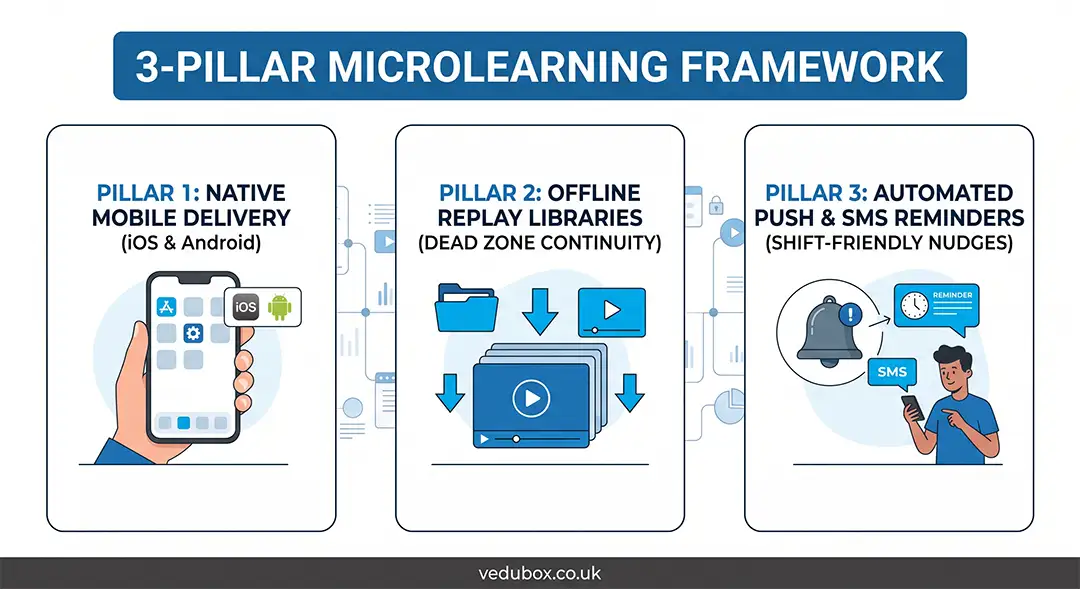
Pillar 1: Bite-Sized Content Delivery via Native Mobile Apps (iOS & Android)
Modularising training into concise, targeted lessons significantly improves engagement and completion. Industry benchmarks compiled by corporate learning providers like Continu and Engagedly frequently report completion rates exceeding 80% for bite-sized modules, compared to roughly 20% to 30% for unmandated, long-form courses. Furthermore, by incorporating cognitive science principles such as the spacing effect and retrieval practice, structured microlearning programmes have been shown to substantially reduce memory decay compared to one-off, massed instruction.
Converting 50-Page Safety SOPs into 3-Minute Interactive Video Checkpoints
Instead of handing workers a dense manual, companies convert standard operating procedures into brief, interactive videos. Workers watch a short clip on load securing and complete a quick checkpoint quiz right on their phones.
Pillar 2: Offline Video Replay Libraries for Uninterrupted Learning in Dead Zones
Offline access ensures training continues even without cellular connectivity. Staff can complete lessons during route breaks or inside signal-shielded loading bays without losing their progress.
Pre-Downloading Critical Yard Safety Modules Before Leaving Depot Wi-Fi
Drivers can download required safety modules while connected to depot Wi-Fi before starting their routes. They can review material at remote drop-off points, and completion data syncs automatically once back online.
Pillar 3: Automated Push & SMS Reminders to Nudge Completion Without Disrupting Shifts
Automated reminders keep training on schedule without manual follow-up from managers. Brief SMS text alerts or push notifications notify workers when a new compliance module is assigned.
Transforming Fleet & Warehouse Enablement with Vedubox
Vedubox offers an integrated solution designed for supply chain teams facing operational constraints.
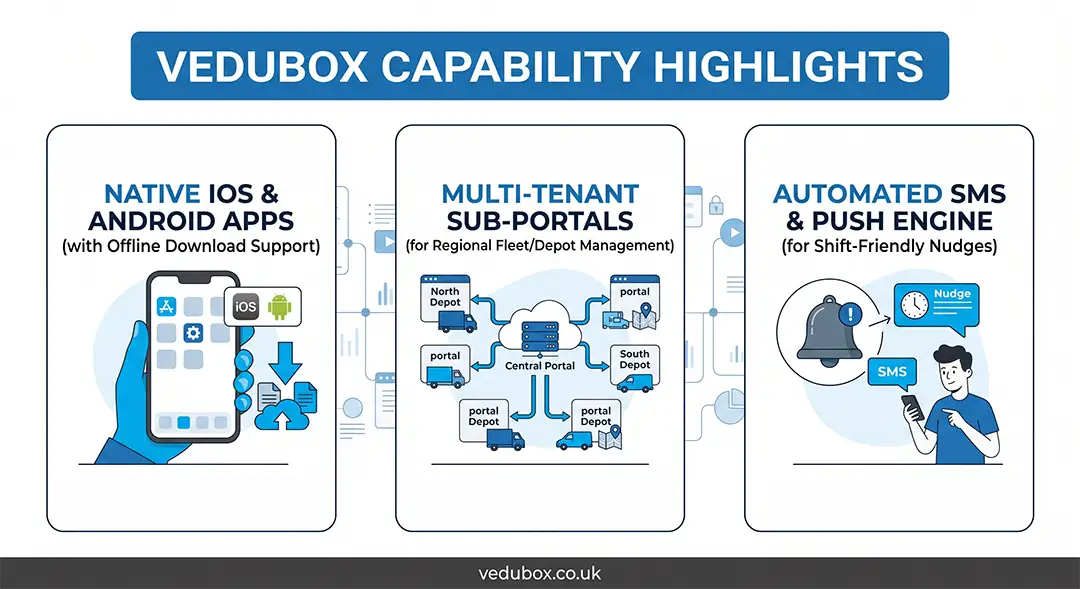
Native Mobile Apps (iOS & Android): Frictionless Learning in the Cab or on the Floor
Vedubox provides dedicated mobile apps for iOS and Android. Drivers and warehouse staff can access training materials on personal or company-issued mobile devices. The intuitive layout makes it straightforward for any team member to navigate courses.
Offline Video Replay Engine: Secure Access in Remote Cargo Terminals
Vedubox features an offline video player that allows users to download modules securely. Staff can watch instructional videos at remote terminals, port yards, or on long highway routes without needing an active data connection.
Automated SMS and Push Notifications: Keeping Drivers Informed on Schedule Updates
Vedubox includes built-in SMS and push notification tools. Operations managers can send brief updates directly to drivers’ mobile phones to announce route changes, safety alerts, or upcoming compliance deadlines.
Training Methodology Comparison: Traditional Classroom vs Vedubox Mobile Microlearning
| Feature / Metric | Traditional Classroom & Desktop LMS | Vedubox Mobile Microlearning Platform |
|---|---|---|
| Completion Rates | 20% - 30% | 80% - 90% |
| Knowledge Retention Boost | Baseline | +25% to +60% |
| Access Hardware | Desktop PC or classroom desk | iOS & Android smartphones / tablets |
| Connectivity Requirement | Continuous broadband | Offline replay mode enabled |
| Regional Multi-Site Control | Fragmented / manual tracking | Multi-tenant sub-portals |
| Deployment Time | Weeks or months | Same-day cloud delivery |
Multi-Tenant Sub-Portals for Regional Fleet and Regional Depot Oversight
Managing training across dozens of distribution centres requires clean administrative controls. Vedubox uses multi-tenant sub-portals, giving regional managers clear oversight of local depot completions while central HR maintains global control over core safety content.
Same-Day Rollout Across Dispersed Terminals
Vedubox operates entirely in the cloud. You do not need to install complex software on depot servers. Operations teams can set up portals, upload micro-modules, and deploy training across dispersed logistics hubs on day one.
Mobilise Your Fleet and Warehouse Operations Today
Deskless workers in supply chain roles need practical, modern learning tools. Transitioning from long desktop modules to mobile microlearning helps reduce safety incidents, improve compliance tracking, and protect operational margins.
Book a personalised Vedubox demo today to see how native mobile apps, offline replay features, and sub-portal management keep your operations compliant and moving forward.



.svg)