











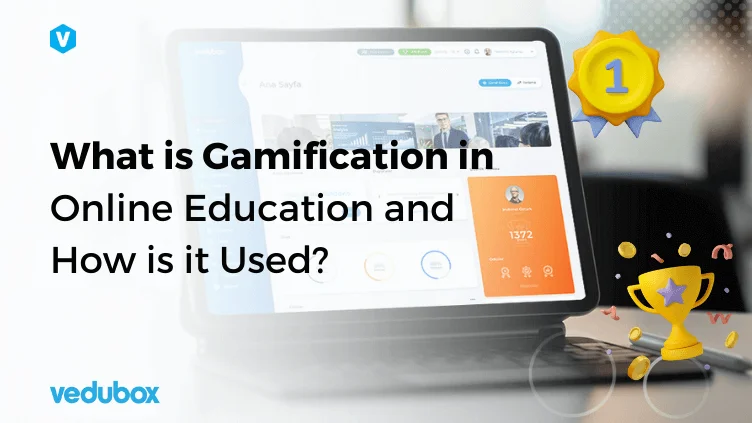
Gamification, or ‘gamification,’ is increasingly used across various types of education. As the number of individuals engaged in online learning and teaching continues to rise, effective methods and tactics are emerging to enhance online learning.
There is no doubt that gamification, whether online or offline, adds a highly effective touch to a learning process.
What Is Gamification?
As children, we learn the foundations of concentration, creativity, and independence through games while having fun. All individuals, in their own ways, enjoy playing games. That’s why including fun elements in learning processes is important for increasing motivation and improving the learning curve.
Numerous studies indicate that games enhance intrinsic motivation for learning and work. So, what exactly is gamification?
Nick Pelling, an English game programmer and IT specialist, posed the question of how unconventional games could provide more contributions in 2002. This is how the process of gamification began.
According to Pelling, gamification is the application of game-like accelerated user interface design to make electronic transactions both fun and fast. In other words, it is the application of game-specific elements and mechanisms to contexts that are generally unrelated to games.
Note: On the other hand, the term “gamification” was first coined by Richard Bartle in 1978, but it did not gain prominence in public discourse at that time.
The concept of gamification was successfully used in the 1930s as a motivational tool to drive customer loyalty, although it wasn’t referred to as such at that time.
In the digital age, gamification focuses on the following:
- optimizing user motivation,
- customer loyalty,
- increasing return on investment,
- improving data quality,
- enhancing the learning experience.
How Is Gamification Used in eLearning?
The technology-based teaching and learning method inspired by Industry 4.0 is referred to as Education 4.0. It aims to develop digital technological competencies, especially for instruction and learning.
Game-Based Learning,’ Serious Games,’ ‘Purposeful Games,’ and ‘Gamification’…
Although it’s a long list of concepts, regardless of their names, they all carry the purpose of harnessing the potential of games in other application contexts. All these concepts are based on the idea of games and utilize technology to go beyond pure entertainment and achieve added value. Terminologies such as gamification, digitalization, and Industry 4.0 are widely used in innovation development processes. Gamification is used to teach complex subject areas in a simple, more enjoyable way through various methods.
Online Education and Gamification
The answer to the question of what gamification is in online education. Online education is a modern and contemporary form of learning. For learning to take place through a computer or smartphone, the user, that is, the student, needs to have tremendous self-discipline. Even in face-to-face education, willingness to learn and a sense of self-discipline are required for learning to occur.
Gamification is, therefore, a method developed to ensure that we do not lose the enjoyment of learning while exploring the future of education. Even freelance university instructors and teachers are currently using games in their webinars and classes. This proves that gamification is becoming a part of our lives. And, of course, it is also becoming an integral part of the concept of online education.
The impact of gamification and video games on products, services, and social interactions is increasingly evident in the field of online education. The ever-increasing digitization poses new challenges to the learning management process, leading to a transformation or complete restructuring of self-management.
Increasing Engagement in Online Education through Gamification
Online education has become essential for everyone to continue their personal development. Online education is relevant not only for young students but also for adults who are continually enhancing their skills. Recently, online education has been improving, and educators are striving to find ways to maintain student motivation and engage them in online courses. Gamification is a fantastic way to increase engagement in online learning.
No matter how courageous as human beings, we tend to be more productive when we enjoy what we do and have fun with games. Many different game-based approaches and versions can be implemented depending on students’ age, interests, and learning goals.
If students find their online homework enjoyable and enjoy doing it, the course’s success rate will be pretty high. This applies even in traditional education. When a teacher creates a competitive atmosphere or makes students feel as if they are playing a game while learning, students will be more motivated and participate more in that teacher’s class than in others.
Especially in eLearning, it can be challenging to keep students actively engaged in the virtual classroom. This is because most of the materials require self-motivation to be completed. You can use gamification tactics to enhance student motivation, such as the following:
- Storytelling
- Game mechanics
- Competition
Story Creation
First and foremost, if the lesson materials resemble a story or are interconnected, you can expect better engagement from your students. Everyone loves stories, and storytelling can help generate more interest in the lesson materials.
Storytelling is a rising star in fields such as presentations, content creation, and learning. If your position requires you to be a speaker or teacher in front of people, this is a significant skill you need to acquire.
Pretending to Be a Game
Secondly, game mechanics would be the right approach for educators to use in online learning. Rather than creating a simple, monotonous lesson filled with memorization and data, you can design it to appear and function like a game, incorporating elements of sound and movement to deliver the same messages.
Instead of simply presenting data to students, we can encourage their active contribution to the lesson materials and make them feel like they are playing a game while solving problems, all to reach a solution.
Creating a Competitive Environment
Lastly, competition is undoubtedly a critical approach to increasing engagement in online classrooms. Regardless of students’ age, they are always more motivated when they strive to achieve a higher rank over time.
Show them where they stand and what they need to do to be at the top. You might be surprised to see how a simple leaderboard can change students’ attitudes.
By applying these three simple gamification rules in online classrooms, you can see how class participation increases.
How Is Gamification Implemented in Online Education?
Alternatively, we can refer to it as the design process of gamification.
Simply adding a few game elements does not fully unlock the potential of gamification. It requires proper implementation to achieve the desired outcome. To assist you in this regard, we will share some ideas that you can use to design your online lessons.
To implement gamification in your online learning materials, it is essential to create a comprehensive plan in advance. Firstly, categorize your gamification tactics and determine your priorities. Additionally, pay close attention to every detail, as it can significantly impact student engagement.
Create a Scoreboard
You can start by planning with a scoreboard.
To increase competition and motivate your students to compete with each other, you can enhance your materials with a scoring system. There should be a specific score awarded for completing each assignment. Additionally, don’t forget to track the time spent on each assignment to prevent students from completing tasks solely to earn more points.
Depending on the duration of the course or training, you can update the leaderboard weekly, monthly, or even daily. Competition is one of the strongest motivators for students of all ages.
Everyone Loves Stories
Moreover, you can plan the entire course with a beginning and an ending, just like a story. If students feel they are part of a journey and that the materials are interconnected and related to one another, they will be more inclined to participate actively.
For example, you can create some mysteries and allow them to solve them only by completing the next task. This tactic is highly effective at engaging online students more actively in online courses.
After all, everyone loves stories.
Make Them Feel Like They Have a Choice
If you’ve ever wondered how people become addicted to online games, the answer is quite simple: they get to make their own decisions.
By employing this tactic, we can engage students in online courses and support their learning.
For instance, instead of having a simple, monotonous lesson material where the student doesn’t have the choice to skip or complete them in any order, you can create them in a way that they find themselves on a different page or topic with each decision they make.
Giving them the freedom to make choices empowers them and makes them more enthusiastic and motivated for the online course.
The use of gamification in online learning has consistently yielded positive results. Whether you are using all of the above tactics or just one of them, you will always see positive outcomes.
There are many great software and tools available that can help you create an engaging classroom. Vedubox, as a product offering online school features, makes it easy to customize and create gamified classrooms. Once you decide on the type of gamification path you want to create, there are two more steps to consider:
Formulate the objective throughout the development process; it is crucial to define a clear goal for using fun elements in online learning from the very beginning.
- What exactly should game elements aim to achieve?
- Should game elements create new competencies?
- Are you focusing on increasing motivation?
- Do you want to make the process more efficient and logical?
- Do you need to simplify the education process or content?
The objective should be clearly formulated and error-free, and it should be able to be recalled if necessary.
Consider measurability. Measuring positive outcomes is as important as the objective itself. Here are some questions that can help you find a way to create measurable games:
- When and how was the objective achieved?
- In what way can you measure the game: qualitatively or quantitatively?
- What kind of tools do you need to measure?
You can use various methods. For example, user surveys, pre- and post-comparisons of productivity data, or an analysis of data quality. Some may require specific applications or software, while others may require qualified personnel to conduct and analyze surveys. Consider your resources and choose your method accordingly.
Conclusion
Integrating game elements into learning processes is not easy. During understanding and integration, you should proceed with caution to avoid the risk of failure with the concept of gamification. When used correctly, gamification is not only capable of optimizing processes but also a powerful tool for motivating employees and retaining customers.
For an online classroom enriched with games, you can always reach out to the Vedubox team and learn more about how to enhance your learning experience.