






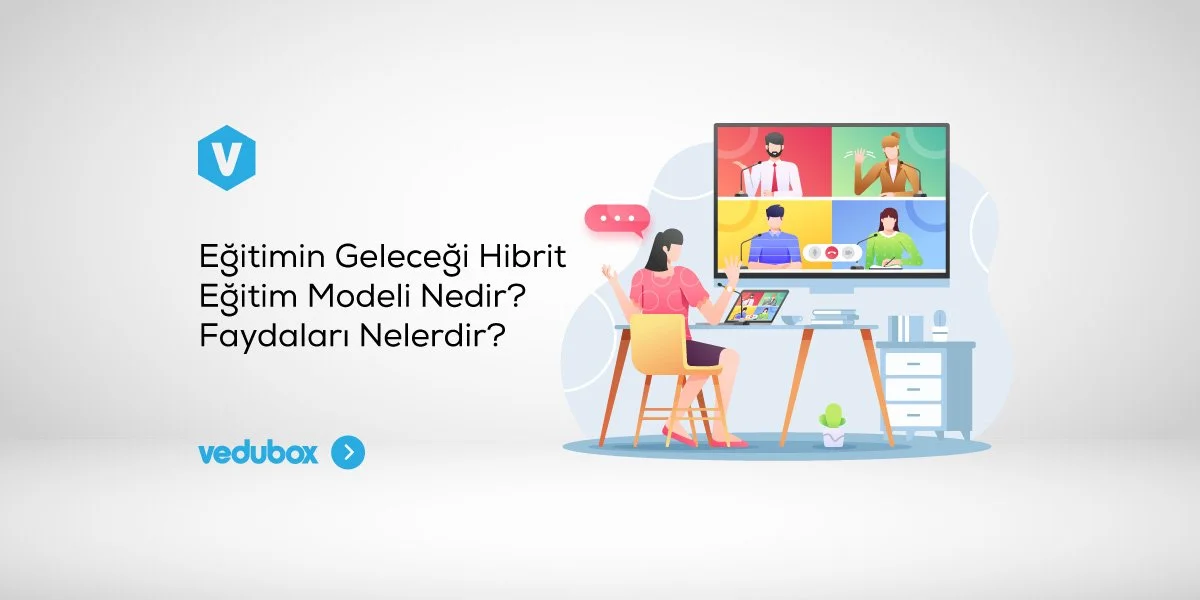
With the hybrid education model, distance education and face-to-face education come together. The strengths of the two models are combined into a single education model.
Educational models are constantly changing and adapting to the flow of life. The development of technology and social events is very influential in this. From the beginning of the 20th century, education systems began to differentiate, with breakthroughs and technological changes in psychology emerging.
Education systems, which have undergone significant changes in a short time compared to their long history, have reached entirely different points with technology today.
The distance education system, which had long been adopted as an alternative education model, suddenly became an essential part of education within a few years. During the pandemic in 2020, and with its effects still ongoing, hundreds of millions of students received distance education.
So, when this pandemic is over, will distance education no longer be used? Will there be a return to the old system? The experts’ consensus is that education will be delivered in a hybrid model.
What Is Hybrid Education?
Hybrid education is an educational model that combines multiple educational approaches. In hybrid education, the goal is to achieve a more successful educational outcome by evaluating the strengths of different models together. For now, the hybrid education model foreseen for the future is that online and face-to-face education will be delivered simultaneously.
In this education model, options such as reinforcing school education with online education at home or making the subject covered at home permanent alongside face-to-face education can be applied.
In fact, the hybrid education model is not new. Even before the compulsory online education process, many institutions and states adopted this model, either through pilot programs or as standard practice. The most obvious example of this education model is the ‘flipped classroom’ system.
In this system, students watch or study the video or educational content given by the teacher or trainer at home. Then they can hold question-and-answer or discussion sessions on these topics in the classroom. Many academic institutions have successfully implemented this system.
With such studies on the hybrid education model, more efficient lessons can be delivered by integrating online and face-to-face instruction. Hereby, the results obtained from the training can be more permanent.
What are the Benefits of Hybrid Education?
There are many benefits of the hybrid education model, which combines online and face-to-face education. These benefits can be diversified across educational institutions, educators, students, and parents. We can list some of them as follows:
1. Ability of Self-Learning
The biggest reason classical education systems cannot meet today’s needs is that they offer ready-made information. As a result of the rote structure of education systems, changes in how the problem is presented can confuse students. For this reason, studies focused on educational practices are applied in new education models.
An environment that presents educational content outside the classroom and discusses it in face-to-face education supports students in this respect. Thus, the student learns to research to get more information.
Thanks to the hybrid education model, students’ self-learning skills develop. Thus, by acquiring information from different angles, he can match the correct information to the problem, even when the problem comes in various forms. They can approach problems more solution-oriented.
2. Time Management
Various methods are being developed to use time effectively and efficiently. Today, when so many distractions surround us, staying focused and using time efficiently has become an invaluable skill.
Hybrid education models help institutions, instructors, and students manage time effectively. Instead of studying 7-8 hours a day, 5 days a week, time can be saved for all participants in the training by moving part of it to the online environment.
3. Efficient Resource Usage
With the increasing population, educational institutions need to serve more people. Classes are now more crowded, or there are more classes in schools. This requires rethinking resource use. School buildings, teachers, and their expenses cost considerable budgets.
With the hybrid education model, some of these resources are eliminated, while others are significantly reduced. For example, smaller school buildings mean less cost.
4. Flexibility in Time, Space, and Application
When you train with the hybrid education model, you can provide flexibility for students, trainers, and institutions. Flexibility in this model can be considered from different perspectives. For example, when video and other educational content are stored in a cloud-based library, students can access them whenever they want. Teachers and students can participate in live lessons whenever and wherever they want.
Thanks to the hybrid education model, which offers flexibility in learning, it can also provide flexibility in practice, in addition to time and space.
- Audio, visual, and mixed resources can be used together for students with different learning styles,
- Gamification techniques can help students learn by making the learning experience more engaging.
- You can process more interactive lessons with the smartboard.
These are just some of them. The LMS features determine the level of flexibility you offer. Therefore, make sure that you are training online with the right LMS.
5. Active Participation in Lesson
Not every student can actively participate in the lesson. It can be challenging for introverted students to speak in class and express their ideas clearly. Some students cannot fully learn the subjects they need to learn during the lesson. While they can, it may take a lot of effort.
Thanks to hybrid models, introverted students who struggle with communication can get a more efficient education through online learning and get answers to their questions by contacting the teacher one-on-one. If they want to fully achieve the teaching, they can reinforce it by watching online lesson materials and live lessons repeatedly. If necessary, they can get support by meeting face-to-face with the teacher.
What is Needed in the Hybrid Education Model?
When an institution adopts a hybrid education model, it requires new tools. When an educational institution starts to provide education with a hybrid education model by combining online education and face-to-face education, it needs the following:
1. LMS – Learning Management System: LMS is the most essential tool for the realization of distance education. LMS is an online tool where
- students can enrol,
- students’ access to educational content,
- Students can communicate with teachers; teachers can assign homework and teach lessons.
“What is LMS?” Check out our related article to get a more detailed answer to the question.
2. Simultaneous Courses: The Online education system should include not only educational content but also simultaneous lessons. A teacher must be able to teach online to their students.
3. Discussion Environment: Just like in physical classrooms, there is a need for a discussion environment in which students can discuss a topic and communicate with their teacher in online lessons.
4. Sharing Educational Content: Educational content is critical in online education. Students should also be able to access educational content online, where they can continue their education whenever they want. For this reason, systems that allow all kinds of academic content to be loaded and accessed by classes and teachers should be selected as the LMS preference.
5. Educational Content Development: Numerous digital tools help teachers and institutions in developing online education content. While the material used in face-to-face education can be easily added to online systems in PDF or Word format, digital content development tools such as Camtasia and Articulate can be used for video tutorials and presentations.
When we consider all these, the advantages of hybrid education models emerge. Suppose an institution wants to adopt a hybrid education model and evaluate both online and face-to-face education. In that case, it is crucial to have a tool that offers all the features expected of an online education tool. In this regard, Vedubox serves institutions as one of the best online education tools in Turkey.
You can visit our website to learn more about Vedubox, which offers online education services to institutions, including live lessons, an LMS, an educational content library, an online exam and question bank system, user management, and an easy-to-use interface that requires no technical knowledge.
Learn more about hybrid education here: Online vs Hybrid Learning: What to expect from the online platform