






While some professions require on-site presence, most jobs allow white-collar workers to work remotely or in a hybrid format, which has almost become the norm. This transformation brought a mandatory change in L&D strategies.
It’s no more efficient to organize physical workshops and training sessions lasting over 20-30 minutes. The challenge may not be new, but it’s been harder to fit those kinds of events into everyone’s calendar. Micro-learning is one of the methods that comes to the rescue.
The Time-poor Workforce
Sometimes, even virtual classrooms aren’t sufficient. Let’s assume that you need to train your workforce in your FinTech company on data protection. An hour-long seminar is not compatible with both your dispersed team and the pace of your industry.
According to research cited by Josh Bersin, the average employee has just 24 minutes a week to dedicate to professional development. That’s less than five minutes a day. If you are still relying on 90-minute webinars or multi-day courses, you are fighting a losing battle against the clock.
Micro-learning is a necessary tool for training and developing your employees in the current business landscape.
What Is Micro-learning?
Micro-learning is more than short bits of a longer training program. While length is a defining factor, the intent also matters. Each bite-sized module focuses on a specific learning objective that the learner can immediately act on.
The logic of micro-learning is to integrate learning into the daily routine, which aligns with contemporary learning practices. For example, when you need to clean your computer’s CPU fans, you don’t enroll in a computer hardware course; you watch a 5-minute YouTube video explaining the step-by-step process.
Micro-learning applies this ‘just-in-time’ logic to workplace skills. Instead of forcing employees to wade through hours of content in search of the answer, you provide them with the exact piece of information they need, precisely when they need it.
Format Examples
Micro-learning examples are incredibly versatile, making them easy to integrate into existing workflows.
- Explainer Videos: Short, animated clips demonstrating practical, instantly actionable applications.
- Interactive Infographics: Visual summaries of complex policies (e.g., security protocols).
- Questions & Quizzes: Quick assessments sent via mobile app to reinforce recent learning.
- Case Study Snippets: Short presentations outlining a specific customer service scenario and the correct response.
Why Adopt Micro-learning?
The reasons to adopt micro-learning may vary depending on your business needs. However, it’s budget-friendly and time-saving, to say the least. Of course, there are other benefits as well.
1. Combatting the Forgetting Curve
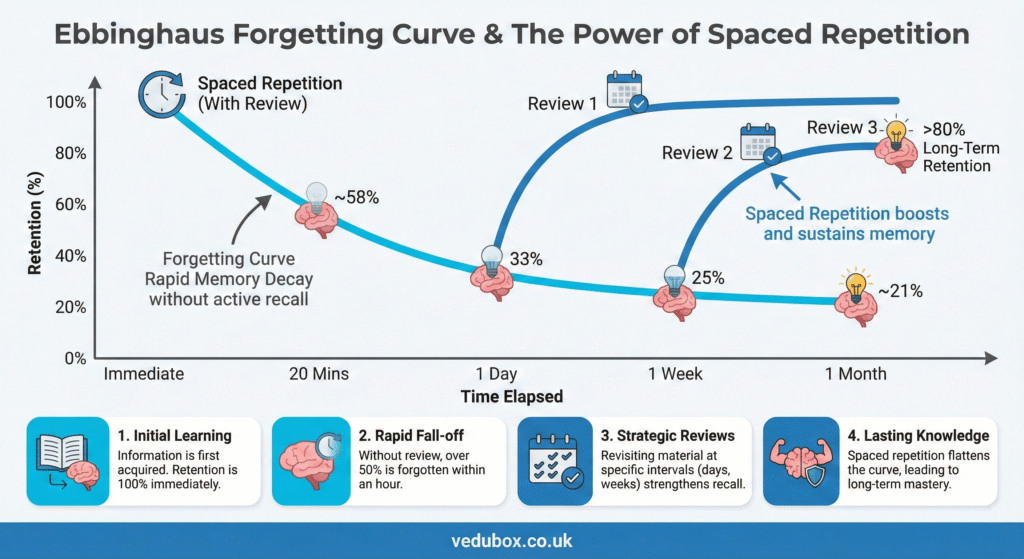
The most significant challenge facing L&D teams is the Ebbinghaus Forgetting Curve, which shows that humans typically forget 50% of new information within an hour of learning it, and 70% within 24 hours. Traditional training dumps information, leading to rapid knowledge decay.
Micro-learning overcomes this by using ‘spaced education’ — or ‘spaced repetition.’ By sending small, relevant knowledge checks or modules over several days and weeks, you reinforce the information precisely when the brain needs a reminder, boosting knowledge retention significantly, according to several studies.
2. Agility for the Market
Updating a 2- to 5-minute video about a specific regulatory change is much faster, cheaper, and more efficient then organizing an at least hour-long seminar or webinar. It’s a win-win for the L&D department and employees.
3. Engagement Wins
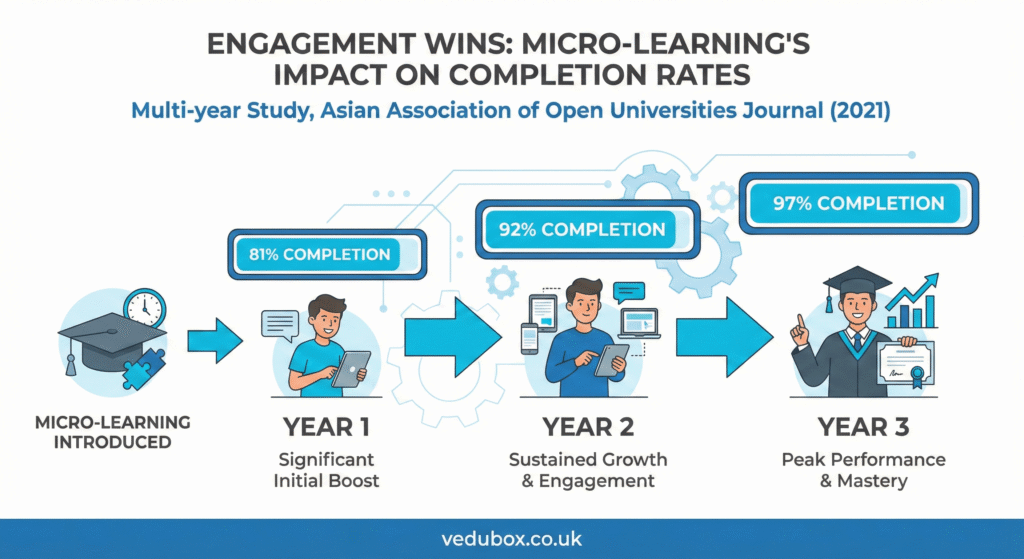
Clicking ‘Play’ on a 45-minute video feels like a chore, but clicking ‘Play’ on a 3-minute video feels manageable. Simple as that.
This psychological difference translates directly into completion rates. A multi-year study published in the Asian Association of Open Universities Journal in 2021 highlights that the introduction of micro-learning elements increased completion rates up to 97% in a three-year course.
How Vedubox Enables This Strategy
Implementing an effective micro-learning strategy requires a platform that manages, delivers, tracks, and reinforces these short bursts of content. We built Vedubox for this modern, flexible approach, turning your valuable content into a continuous, engaging learning experience.
Easy-to-Browse Library
Vedubox doesn’t treat your content like files in a dusty server folder. It allows L&D managers to curate highly focused micro-learning playlists. Learners can browse, search, and consume content based on their immediate needs. If a sales rep needs help with objection handling, they can instantly access a playlist of 3-minute video lessons on that specific topic.
Mobile-first and On-demand
For the hybrid worker, training must be accessible anywhere. Vedubox is fully responsive and mobile-optimized. Staff can easily watch a training clip during their commute or while waiting for a meeting. It’s almost like scrolling through Instagram Reels.
Engagement Driven by Gamification
Because bite-sized learning is inherently frequent, it pairs perfectly with gamification. Vedubox’s built-in features — including badges, points, and leaderboards — turn these short, essential tasks into a competitive and engaging team activity.
Micro-learning is the pragmatic answer to a fast-paced, digital working environment. It respects your employees’ time, optimizes your company’s training budget, and — most importantly — delivers far excellent knowledge retention.
By breaking down complex information into highly relevant, bite-sized learning modules, you turn learning from an occasional, disruptive chore into a continuous, daily habit.
Explore Vedubox’s all-in-one platform via a trial run to see how we can help you design, deploy, and track your next generation of micro-learning examples. Or speak to a Vedubox specialist and discover the power of focused, flexible training.