










The shift to digital corporate training and remote learning throughout the pandemic was necessary. However, its legacy pushed organizations and institutions towards adopting hybrid and blended learning models. This transformation brought a significant challenge in proctoring tests, though.
There is a conflict between securing the integrity of the qualifications awarded and ethically — and legally — proctoring the exam-takers without violating their privacy.
What Is Online Exam Proctoring and How Does It Work?
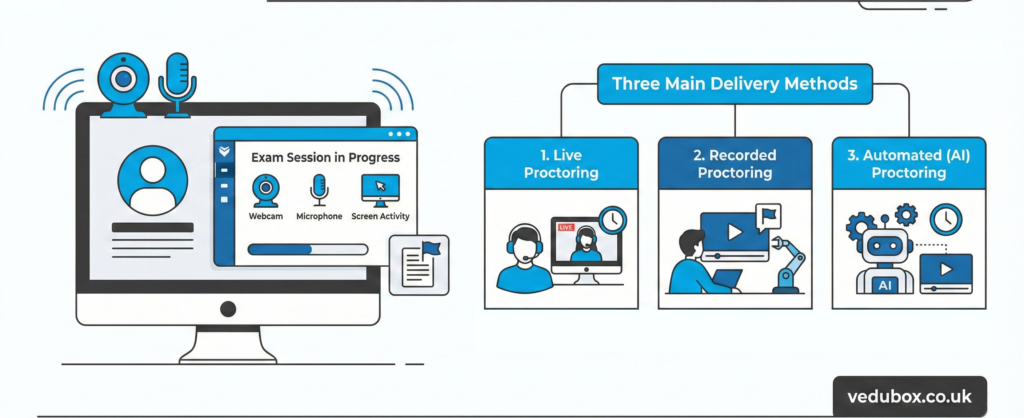
Let’s start with the basics to understand online proctoring, sometimes referred to as remote invigilation (remote supervision of exams). Instead of relying on a physical proctor walking up and down rows of desks, specialized software monitors the test-taker using a combination of their webcam, microphone, and screen activity.
There are three main delivery methods for online proctoring.
1. Live Proctoring
In live proctoring, a human invigilator monitors the test-taker in real time throughout the assessment. This option is rather expensive because it’s the most personnel-intensive, but offers the highest level of prevention.
2. Recorded Proctoring
A human overseer and AI work together in recorded proctoring. AI flags suspicious behaviour while reviewing the recorded session, and a human evaluates these potential issues. This approach is considered safer and more balanced than live proctoring and our next method, automated proctoring (also known as AI proctoring).
3. Automated (AI) Proctoring
AI proctoring is the most scalable method. Similar to recorded proctoring, an algorithm flags suspicious behaviour, but in real time, unlike recorded proctoring. Of course, these flagged behaviours are then reviewed by humans for a definitive decision.
How Do Online Proctored Exams Detect Cheating?
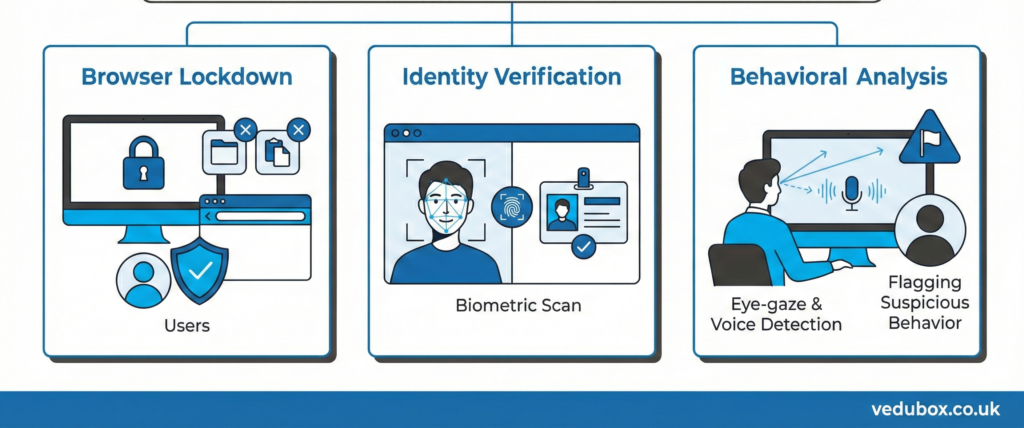
Online assessment is a constant ‘cat-and-mouse’ game. While test-takers improve cheating methods, such as second devices, screen sharing, and AI bots, online exam monitoring technology needs to evolve to respond to these, while staying within the regulated framework.
Modern systems integrate several key features to maintain exam integrity.
Browser Lockdown
Browser lockdown ensures an isolated environment. A specialized browser or browser plugin prevents the test-taker from opening new tabs, accessing other applications, or using copy-and-paste functions during the assessment.
Identity Verification
Before the exam begins, AI facial recognition software verifies the test-taker by matching their live image to a previously uploaded photo. This process prevents impersonation and ensures the right person is sitting the exam.
Behavioral Analysis
Here is where AI excels. Advanced systems monitor patterns that suggest deceit, including tracking eye-gaze patterns, detecting multiple voices in the room, or flagging instances where the test-taker is replaced by another individual mid-exam. This level of detail ensures that even subtle attempts at cheating are documented.
Data Privacy & GDPR
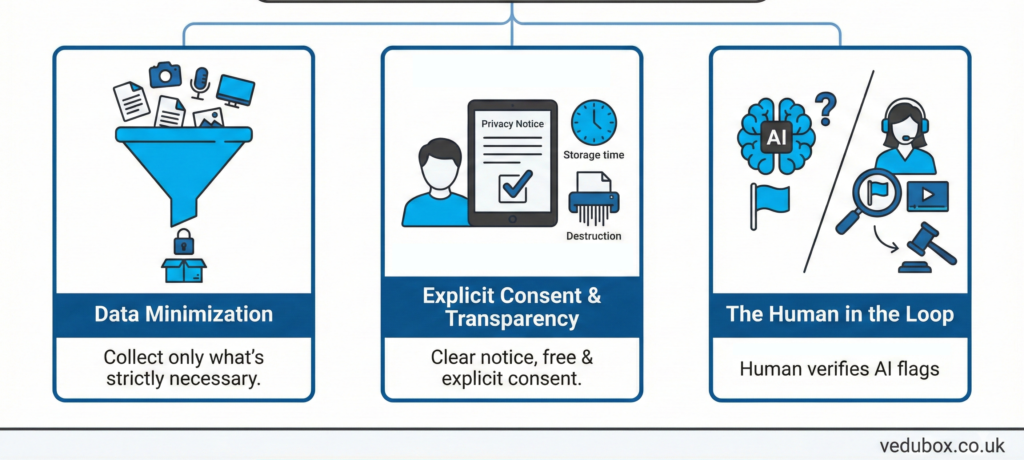
There is a legitimate compliance concern for organizations and institutions. Filming exam participants, capturing their IDs and profile photos, and accessing their personal devices to lock certain functions, even for surveillance and test integrity, might violate security and privacy laws.
You should be transparent and carefully design the process.
Data Minimization
Test-takers must be provided with clear, detailed privacy notices. Especially in the following three areas.
- Why the data (video, audio, screen activity) is being collected.
- How long it will be stored.
- When and how it will be destroyed (usually immediately after the review period).
Consent must be freely given and explicit before the proctoring session can begin.
The Human in the Loop
Purely algorithmic decisions carry legal risk under GDPR. If an AI automatically fails a test-taker because a shadow or a pet triggered an alert, this could be challenged. To mitigate this issue, a human invigilator must verify the flag generated by the AI before any disciplinary action. This hybrid approach lays a strong foundation for legal defensibility.
Trends to Watch
The evolution of remote invigilation is rapid, driven by the need to combat increasingly sophisticated digital tools.
Hybrid Proctoring
The most effective and ethical approach is the merging of the automated and human elements. AI flags suspicious behaviour, but a trained human makes the final judgment, significantly reducing ‘false positives’ and creating a more reliable environment.
Detecting Generative Content
A major emerging threat is the use of Generative AI (GenAI), such as ChatGPT or Gemini, to produce exam answers in real-time. New online exam proctoring tools are being developed specifically to detect if a candidate is toggling between the assessment and a GenAI tool, or even analyzing writing style shifts that suggest external assistance.
Mobile Proctoring
For assessments requiring a full 360-degree view of the test environment, test-takers are increasingly required to use their smartphone as a secondary camera, providing a comprehensive view of the entire workspace.
Security Without the Headache
For L&D leaders, the prospect of managing a separate, expensive proctoring solution (like integrating ExamSoft or Proctorio) can be overwhelming.
Vedubox offers built-in, secure exam modules that eliminate the need for third-party software while maintaining uncompromising integrity. Our system integrates powerful features directly into your existing LMS ecosystem, such as the following.
- Safe Exam Browser Integration: Locking down the test-taker’s environment instantly.
- Question Randomization: Ensuring no two test-takers receive the same exam sequence.
- Customizable Security Levels: Allowing you to select the appropriate level of proctoring based on the stakes of the certification.
Both securing your exam’s integrity and compliance are the primary benefits when your LMS and assessment system communicate flawlessly. You can easily create a secure, customizable, and compliant environment. Whether you are a university, a corporate training provider, or a solo course creator, protecting exam integrity protects your reputation, market value, and legal standing.
Contact us if you have further questions or concerns, and we can discuss how Vedubox can help you build the secure, compliant exam environment you need.