

Attracting and retaining skilled talent is among the primary concerns for C-Level executives and L&D leaders. The ‘Great Resignation’ has evolved to ‘Great Reshuffle,’ where employees are not leaving the workforce entirely, but are strategically moving to organizations that offer a clearer, more engaging future.
Skills shortage and employee retention are critical challenges that almost all employers face in the current business environment. Job-hopping is extremely normalized, and the reason is not only compensation.
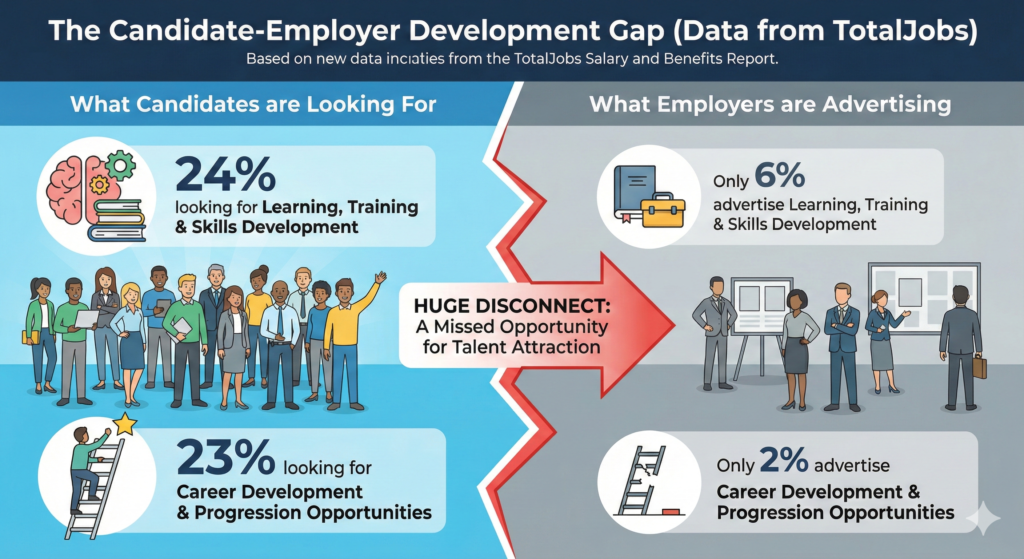
According to the TotalJobs Salary and Benefits Report, 24% of candidates are looking for jobs that offer learning, training, and skills development, and 23% for career development and progression opportunities. However, only 6% and 2% of employers advertise these benefits.
These data suggest that companies need to understand the importance of employee development and create more effective strategies to attract and retain talent.
What Is Employee Development?
For executives struggling with retention metrics, understanding the strategic difference between standard training and genuine development is crucial.
At its core, employee development is a collaborative, long-term, strategic process in which the employee and employer work together to systematically upgrade the skills, knowledge, and competencies required for future roles.
Training versus Development
L&D budgets are often scrutinized, making it vital to justify investment by clarifying its strategic intent. While training focuses on ‘what the employee needs to do now,’ development focuses on ‘who the employee needs to become next.’
Feature | Employee Training | Employee Development |
Time Horizon | Short-term, immediate | Long-term, continuous |
Goal | Reactive; fixing a current performance gap or ensuring compliance (e.g., GDPR, new CRM system use). | Proactive; building future capability, leadership pipelines, and career resilience. |
Focus | Job-specific tasks and knowledge. | Broad competencies, soft skills, strategic thinking, and personal growth. |
Investment Return | Immediate productivity lift. | Staff retention, succession planning, and innovation. |
The Unbreakable Link Between Development and Retention
In the modern workplace, employees — particularly younger generations — view growth opportunities as currency, an essential part of their psychological contract with their employer. If that growth stalls, they will look elsewhere.
This reality is evidenced by robust international data: the LinkedIn Workplace Learning Report confirms that “providing learning opportunities is the No. 1 retention strategy.” Companies with a strong learning culture have 57% higher retention rates.
Development as a Career Anchor
In a competitive market, where highly skilled candidates are scarce, the commitment to staff development becomes a critical differentiator.
Data show that when an organization offers a clear, personalized employee development plan, it acts as a ‘career anchor,’ providing stability and a vested interest in the company’s long-term success.
Failing to invest in development carries significant hidden costs beyond high turnover. It fosters stagnation, reduces innovation, and encourages ‘quiet quitting.’ Development is not merely a benefit; it is an essential risk-mitigation strategy against organizational decay.
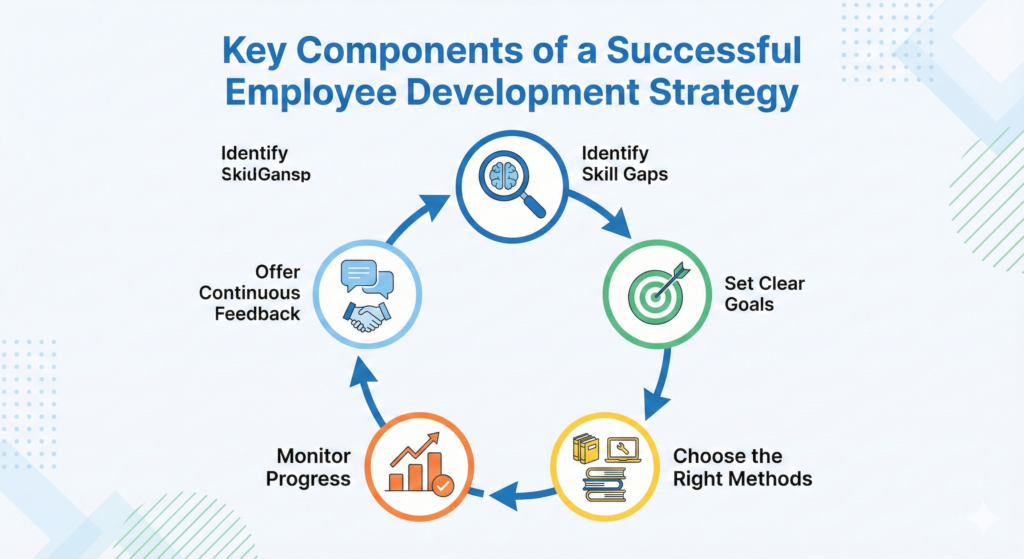
Key Components of a Successful Strategy
A good development plan goes beyond ad-hoc courses and makes learning a regular part of the workweek.
Personalized Pathways and Bespoke Employee Development Plans
L&D directors must implement bespoke employee development plans tailored to individual career aspirations. This personalization signals respect for the employee’s unique journey and drives engagement.
Cultivating a Continuous Learning Culture
Development must be continuous, accessible, and iterative. Achieving development goals requires encouraging a culture where learning is valued, promoted, and protected — with dedicated time allocated for developmental activities.
An effective strategy relies on blended approaches, combining formal employee development training (structured courses, qualifications) with high-value informal methods, such as the following.
- Cross-functional secondments.
- Structured mentorship and coaching programs.
- Peer-to-peer knowledge sharing and internal communities of practice.
How to Implement an Easy-to-Track Employee Development
Designing the development strategy is mostly the easy part. The challenge is efficiently executing and tracking various personalized development paths simultaneously.
Strategic Gap Analysis
Before investing, perform a comprehensive gap analysis to align business objectives and development initiatives. Identify where the business is strategically heading (e.g., digital transformation, new market entry) and map the current talent capabilities against these future requirements.
The Technology Enabler
Managing complex, individualized employee development plans across departments is impossible via fragmented spreadsheets and shared drives. To streamline admin work and increase efficiency, utilizing an integrated learning technology can help you in three areas.
- Delivery: Providing continuous access to blended learning content (formal courses, virtual classroom sessions, and self-paced materials).
- Personalization: Automatically assigning specific development paths based on role, performance, and career goals.
- Tracking: Measuring completion rates, engagement levels, and skill acquisition automatically, freeing up L&D time for strategic coaching.
Measure Impact and Prove ROI
To secure continued board buy-in, L&D must demonstrate that employee development is a cost-saver.
The most compelling metric is retention itself. Track the following.
- Internal Promotion Rates: An increase in internal promotions over external hires demonstrates that the development pipeline is functioning and saving significant recruitment costs.
- Time-to-Competency: How quickly developed staff reach full productivity in new roles.
- Voluntary Turnover Rates: A direct correlation between sustained development investment and a drop in voluntary resignations is the ultimate proof of ROI.
Understanding employee development is the first step toward transforming your organization from a mere ‘stepping stone’ into a career destination. In a competitive labor market, a commitment to growth is a fundamental expectation that underpins employee loyalty.
A robust, technology-enabled staff development strategy ensures that your people feel valued, see a clear future, and possess the skills necessary for your organization’s long-term success.
Let’s have a call to discuss how Vedubox can help develop your organization’s core staff, who will impact its long-term success.