










Network marketing companies, often called multi-level marketing or MLM firms, can generate impressive revenues. Yet, they face real challenges, especially when it comes to training their sales teams. With a workforce made up of volunteers, motivating people to take part in training is a constant struggle.
The most effective teams are those that invest in training. It helps prevent compliance problems, spreads successful strategies, and builds up skills where they are needed most. Encouraging participation and tracking how training shapes real-world results are key steps to building a stronger network.
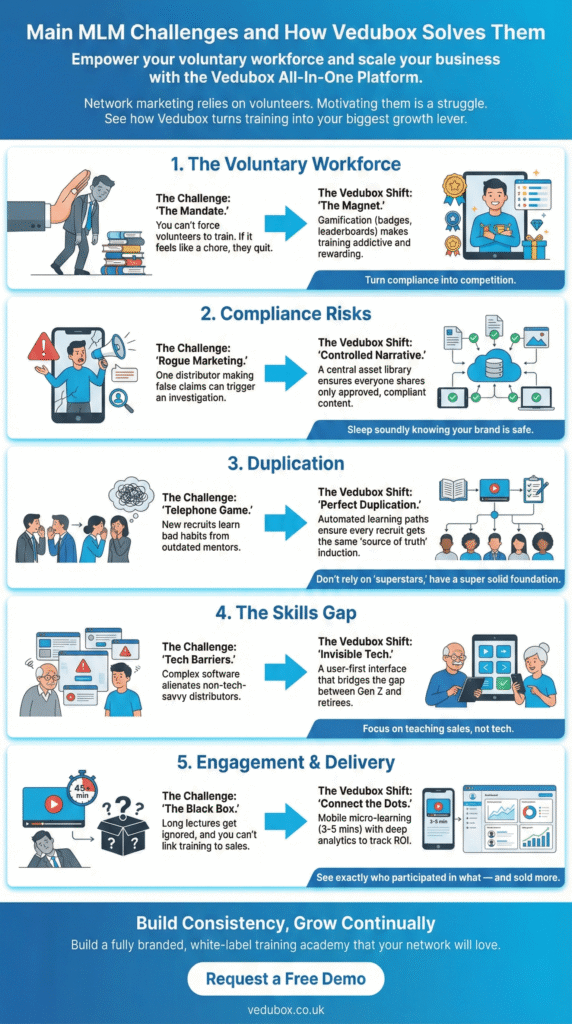
Main MLM Challenges and How Vedubox Solves Them
MLM companies often face five persistent challenges. Vedubox offers a flexible and scalable platform designed to help teams overcome these obstacles with thorough sales training.
1. Voluntary Workforce
Perhaps the biggest challenge for any network marketing company is that the sales force is made up of volunteers. Unlike regular employees, distributors can walk away at any time, often without warning. This model causes high turnover and little authority to insist that anyone completes a training or sticks to a schedule.
Companies need a training environment that draws people in rather than one that feels like an obligation to overcome this challenge. The system should offer real, immediate value, so volunteers see training as a way to boost their own success.
But building this kind of environment is tough, since what motivates one person might not work for another. Most traditional training platforms feel corporate and rigid, which can put off the independent, entrepreneurial mindset of network marketers. If the platform feels like work with no clear reward, people simply tune out.
Social learning and gamification elements transform training into a rewarding journey. When a salesperson completes training and assessments, you can award them badges and certificates, and ignite some friendly competition with leaderboards.
The result is a shift from people feeling forced to take part to actually wanting to join in. Distributors see others succeeding and are motivated to reach the next level themselves.
Over time, training becomes part of the culture. What once felt like a chore turns into a real benefit of joining the network, helping people stick around and feel loyal to the team.
2. Compliance & Regulatory Issues
In the UK and globally, regulatory scrutiny on income and product claims is intensifying. Unlike traditional B2B sales, where a compliance breach might be an internal HR issue, a single distributor making false claims on social media can trigger investigations from bodies like the ASA or CMA, potentially shutting the company down.
The solution lies in absolute control over the narrative. The company must ensure that every piece of information shared by a distributor has been vetted, approved, and stamped for compliance before it ever reaches the public domain.
Granting this much control to at least hundreds of independent agents may seem logistically impossible. You must find the fine line between policing your team and giving them complete freedom. The latter invites legal trouble while the former hurts morale.
Providing your team with clear instructions that define the regulatory and legal framework as well as boundries solve this issue. Vedubox’s content libraries ensure the distributors have access to compliant, up-to-date materials. You can quickly update assets in response to a regulatory change and instantly notify the entire team.
This approach cuts down the risk of off-message marketing. You can be confident that your team shares matches what was approved at headquarters and is compliant with regulations.
Compliance stops feeling like a crackdown and becomes a normal part of how things work — unseen by most distributors, but strong enough to protect the whole company.
3. Duplication
Success in network marketing mostly depends on duplication. New recruits usually copy those who brought them in — like they copied their own recruiters. However, some leaders may use outdated or questionable tactics that may spread quickly through the team.
For real growth and brand integrity, everyone needs the same training experience. You must adopt a franchise-like mentality, where the system also handles onboarding.
The challenge is that top leaders often prefer their own way of doing things. Standardizing training can feel like you’re taking away what makes them successful.
While Vedubox enables a standardized onboarding experience, it also allows you to create personalized learning paths. Your best sellers can still mentor, but the foundational knowledge is centralized.
Vedubox provides a white-label, unified platform that standardizes the onboarding journey. We allow you to create automated learning paths that every new recruit must travel. The superstar can still mentor, but the foundational knowledge comes from a single, uncorrupted source of truth.
This centralization and standardization ensure that your recruits in London and Manchester receive the same high-quality induction.
You can rely on the process, but the standout performers also become assets that can add extra value as mentors.
4. Skills Gap
People’s digital skills vary in network marketing because they come from different backgrounds and represent a wide range of generations, from Boomers to Gen Zers. New recruits also may have hard time telling the difference between spamming and persuading.
The best training technology is almost invisible. It should be simple enough for anyone to use, but still powerful enough to deliver up-to-date content. At the same time, the training needs to connect product knowledge with real sales skills.
Most platforms swing between two extremes: complicated business software or apps that are too basic. Striking a balance that works for both a grandmother on an iPad and a student on a smartphone is no small feat.
Your team could intuitively utilize Vedubox because we created it with a ‘user-first’ approach. The platform supports videos, text, and interactive quizzes, letting people of all ages learn in the way that works best for them.
When technology is easy to use, barriers disappear. People can focus on the content, and distributors of any age feel more confident using digital tools.
Digital skills become the norm across the network. Instead of asking how to use the platform, people start asking how it can help them sell more, putting everyone on equal footing.
5. Engagement & Delivery
To encourage learning, you must create bite-sized lessons because distributors mostly consume content in short time windows during the day. So, nobody will watch a 45-minute lesson in one sitting.
Training needs to be short — just three to five minutes — easy to watch on a phone, and trackable. The goal is to connect the dots between watching a video and making a sale.
The challenge is breaking down complex training into small pieces without losing what matters. It’s also tough to link offline sales back to online training, since most basic video platforms can’t track that kind of data.
We built Vedubox for the modern, mobile learner. Our platform supports short, focused lessons and offers detailed reporting. You can see exactly who watched what, when, and for how long, making it possible to link training to real sales results.
When training fits into a busy day, completion rates go up. Companies can finally see the data that shows, for example, distributors who watch a five-minute video end up selling more.
Training based on real data becomes standard. Instead of guessing what works, you can fine-tune your content using solid evidence, leading to ongoing improvement and growth.
A Flexible and Scalable Solution for Network Marketing Companies
Vedubox is a secure, cloud-based platform that lets companies build a fully branded training and sales support system. The white-label approach means the platform can be shaped to fit your company’s identity from top to bottom.
If you want to make your network marketing business run more smoothly and grow, Vedubox is worth a closer look. You can try a free demo to see how it works in practice.