










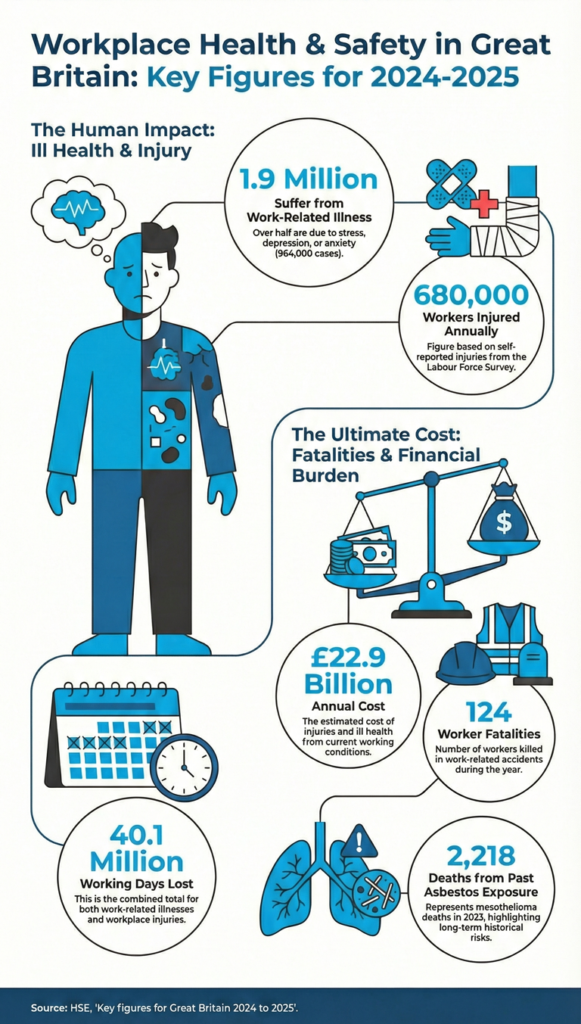
In 2025, over 120 people were killed in work-related accidents, while nearly 2 million suffered work-related illnesses, whether psychological, like musculoskeletal disorders, or psychological, such as stress, depression, or anxiety. The total estimated cost of injuries and ill health from current working conditions is almost £23 billion, according to HSE’s 2025 stats.
As an employer, you are required to protect your people’s well-being under the Health and Safety at Work etc. Act 1974. Occupational Health and Safety training is not only a financial measure for safeguarding your business; it’s also a moral obligation to your workers. So, you must find a way to provide it efficiently and effectively.
The ‘Forgettable’ Classroom Problem
In busy industries like manufacturing or healthcare, stacking everyone in one place once a year is obsolete and an unnecessary expense of time and money. Additionally, modifying shifts requires extra admin work.
Worse still, it often doesn’t work. Some studies show that most people forget what they’ve learned in these sessions almost as soon as they leave the room. If someone can’t remember how to handle a chemical or use a machine safely, the training has failed and left everyone at risk.
The Digital Shift
Digital platforms offer a way out of this cycle. Instead of rigid schedules, they make safety training part of everyday work.
1. Training That Fits the Shift Pattern
One of the biggest challenges for L&D leaders is finding a time when everyone can attend. With digital platforms, they don’t have to juggle schedules or pull people off the job.
Employees can complete modules on manual handling or fire safety during downtime, directly from their mobile devices.
For topics that require a human touch, integrations like Zoom and Microsoft Teams help run live safety briefings for geographically dispersed teams simultaneously. These tools also enable session recordings, so anyone on the night shift can watch later.
2. Evidence of Competence
In the event of an HSE inspection or an insurance claim, a crumpled sign-in sheet is weak evidence. You need concrete proof that training was delivered, understood, and certified.
In delicate training topics like health and safety, finishing a course is barely enough. Quizzes and interactive video questions enable tracking of employees who really understood the topic and who need to review what they didn’t. So, your certifications serve as proof of competence rather than mere completion.
3. Rapid Deployment of New Regulations
Safety guidelines evolve. When a new regulation regarding PPE or social distancing comes into force, you cannot wait six months for the next training day. A digital platform allows you to upload a new PDF guide, video briefing, or policy document and assign it to your entire workforce in minutes. You can then track exactly who has opened it and who hasn’t.
A Step-by-Step Guide to Digital Safety
Migrating your OHS strategy to a digital platform, like Vedubox, gives your safety officer better tools. They can follow four easy steps to transform training from an in-person, classroom experience to a ubiquitous one.
- Centralizing Assets: Upload your existing risk assessments, COSHH data sheets, and training videos into the Vedubox library.
- Creating Learning Paths: Don’t overwhelm staff. Create specific modules for specific roles—warehouse staff get forklift safety, while office staff get DSE (Display Screen Equipment) training.
- Engaging and Verifying: Use the ‘Gamification’ features to reward teams for high compliance rates. Use the ‘Exam’ module to run annual compliance refreshers with randomized questions to prevent cheating.
- Monitoring and Tracking: Stop guessing who is compliant. The Vedubox reporting dashboard gives you a Red/Amber/Green status on every employee’s training progress, essential for reporting to the board.
Occupational Health and Safety is the foundation of trust between an employer and their people.
By moving away from expensive, disjointed classroom sessions and embracing a cohesive digital platform like Vedubox, you reduce costs and administrative burden. But more importantly, you ensure that safety knowledge is accessible, engaging, and retained. In the high-stakes environment of UK industry, that difference saves lives.
Contact us today, and we will help you digitize your training routine.