


While workshops offer opportunities for team building and introducing new concepts to employees, which they can apply in the workplace, their effects are mostly ephemeral. If your approach to upskilling is limited to once or twice-a-year events, your L&D strategy is fundamentally broken.
Additionally, one-size-fits-all training is inefficient, and you might be wasting significant potential within your workforce.
Indeed, the LinkedIn Workplace Learning Report highlights that 94% of employees would stay at a company longer if it invested in their learning. However, the quality and efficiency of the investment matter as well. The solution lies in adopting a continuous learning culture and offering personalized growth paths to your employees.
What Does a ‘Continuous Learning Culture’ Look Like?
The primary goal in a continuous learning environment is to make professional growth an everyday component of work. It means learning and development are fully integrated into the daily workflow.
Key Characteristics of a Learning Culture
In an enterprise with a continuous learning culture, the workforce is agile, innovative, and inherently resilient to market changes, as it constantly adapts. There are three leading characteristics in such workplaces, while there may be more.
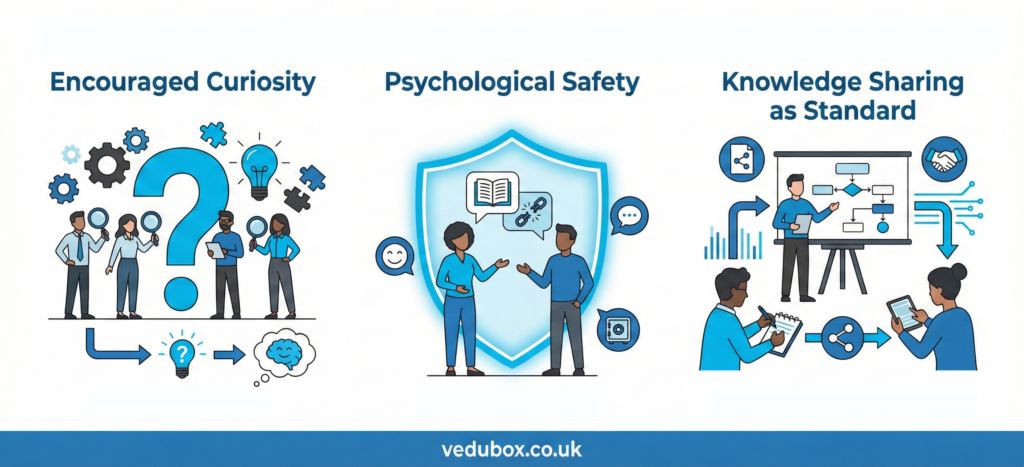
- Encouraged Curiosity
The staff is encouraged to improve themselves to solve complex business problems. They are not afraid to fail, but learn from methods that don’t work — these ‘failures’ are considered opportunities to learn and improve performance. - Psychological Safety
Not being afraid to make mistakes creates a safe environment for employees. They are more likely to collaborate, ask difficult questions, and be open to experimentation. This supportive environment and safety ultimately contribute to innovation and long-term business success. - Knowledge Sharing as Standard
All team members become teachers at one point. A sales team member provides support to a marketing team member on effectively using certain CRM features. Also, a BI specialist helps a sales representative make sense of consumer behaviour data. Internal knowledge exchange sets the company free of silos.
Practical Strategies for Implementation
Creating a continuous learning culture does not need to be expensive or laborious. You can implement high-impact strategies at low costs, leveraging internal expertise.
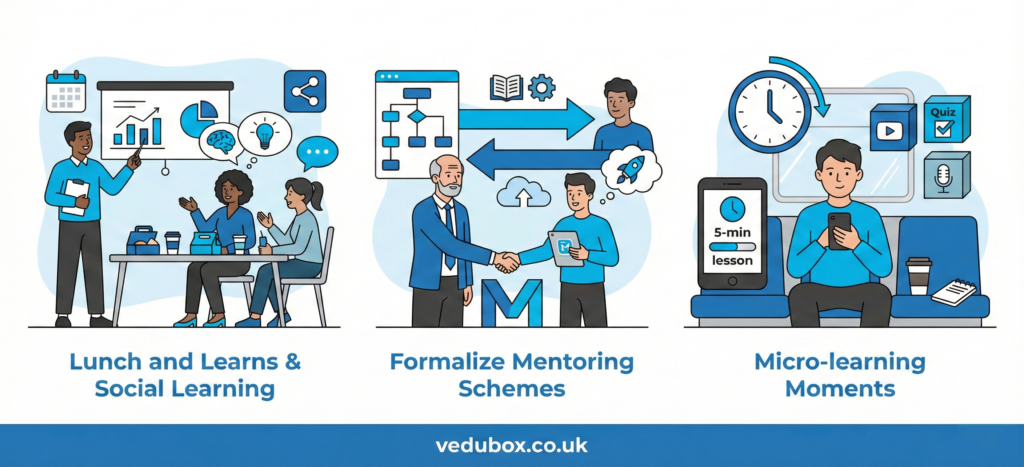
‘Lunch and Learns’ & Social Learning
Start encouraging internal Subject Matter Experts (SMEs) to host casual, 30-minute lunchtime sessions. These sessions are perfect for sharing departmental knowledge, explaining new software roll-outs, or discussing industry trends.
You can help give the presenters a motivational boost by recognizing their expertise and also facilitate critical cross-departmental communication.
Formalize Mentoring Schemes
Mentoring schemes lay a strong foundation for effective peer-to-peer training and development programs. By formalizing these schemes, you ensure efficient transfer of institutional knowledge.
While hierarchical assignments help pass on internal knowledge — such as assigning a senior mentor to a junior employee — ‘reverse mentoring’ is also beneficial. For example, a junior Gen Z staff member can mentor senior leaders in crucial digital trends or emerging technologies.
Micro-learning Moments
Breaking down comprehensive subjects into ‘bite-sized’ (5-10 minutes) pieces maintains focus and reinforces learning.
Train your managers to facilitate these quick lectures. A simple question like “What’s one new thing you learned this week, and how can it help the team?” in a short meeting creates incredible value for employees to invest in these short lessons.
The Essential Role of HR and Leadership
A culture of learning cannot be delegated; it must be demonstrably led from the top. If the C-suite treats training as optional or an inconvenience, the workforce will follow suit.
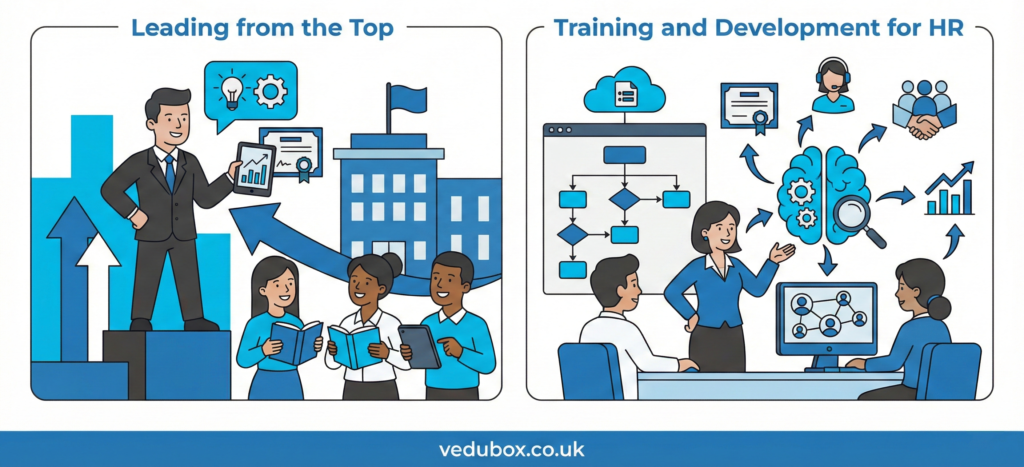
Leading from the Top
Leaders must become genuine ‘Chief Learning Officers’ by visibly participating in training programs, utilizing the company’s LMS, and sharing their own learning journeys. When the CEO commits 30 minutes to a micro-learning module, it sends a powerful message that learning is a strategic priority.
Training and Development for HR
Lorem ipsum dolor sit amet, consectetur adipiscing elit. Ut elit tellus, luctus nec ullamcorper mattis, pulvinar dapibus leo.
The function of HR and L&D teams must evolve significantly. Training and development for HR professionals must shift from being ‘course admins’ to ‘learning experience architects.’ They should curate content, connect learners, and accurately measure learning impact.
The Right LMS Enables Culture
Scaling an enterprise-wide learning culture requires more than spreadsheets and shared folders. A system that enables your staff to easily access and contribute to learning materials and integrates quiz, analysis, and reporting tools is fundamental to building a solid base, like Vedubox.
Accessibility and Integration
Vedubox makes learning available 24/7. Employees can access mandatory compliance courses, leadership programs, or micro-learning modules on their mobile devices during their commute or downtime.
Social Features
Vedubox’s discussion forums, community features, and knowledge-sharing portals ensure that the conversation continues beyond formal training sessions and virtual classrooms.
Data-driven Insights
Vedubox provides precise data on who is engaging, what content drives the highest completion rates, and crucially, how engagement correlates with performance metrics. L&D leaders can refine the learning strategy in real time, ensuring resources are focused on the highest-impact interventions.
Shifting your enterprise to a continuous-learning culture is an incredibly strategic investment. It creates an organizational asset that grows over time, resulting in higher retention, greater innovation, and a more agile workforce.
By embedding social learning, linking development to performance, and supporting your strategy with technology, you move past one-time events toward lasting, measurable growth.