










The implementation of artificial intelligence to automate routine tasks increases efficiency, but it also carries risks. Human judgement has always been — and will always be — the critical element that drives genuine innovation. So, it becomes more ‘premium’ to have an edge in an environment where AI starts to take over.
The term ‘AI slop’ didn’t come from jealousy or envy. While it usually describes AI-generated ‘art’ or ‘design,’ it can also describe any field in which AI is used, such as developing marketing, business growth, or corporate training strategies.
Reflective intelligence is the skill to avoid the ‘slop.’
What Is Reflective Intelligence?
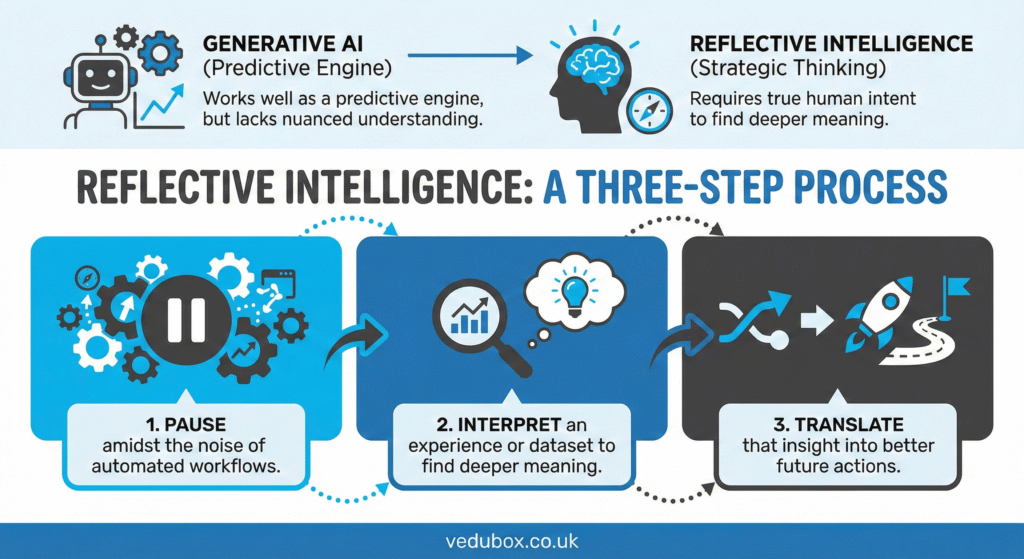
Generative AI works well as a predictive engine, but it lacks the nuanced understanding that requires strategic thinking and true human intent. In this context, reflective intelligence refers to the ability to undergo a three-step process.
- Pause amidst the noise of automated workflows.
- Interpret an experience or dataset to find deeper meaning.
- Translate that insight into better future actions.
The Business Case for the ‘Strategic Pause’
The rapid pace of AI takeover makes acquiring and improving reflective intelligence skills an urgent priority, regardless of your organization’s size, for several reasons.
AI can iterate on existing patterns, but it never leaps to new paradigms. Reflective employees who can critically analyze the reasons for a project’s failure or success are the ones who have the ability to drive genuine innovation.
Wisdom is not artificial. It needs the human element. In a data-rich environment, ‘analysis paralysis’ is a real threat. Leaders with high reflective intelligence can cut through the noise and make wiser strategic choices.
Self-regulation and the ability to learn from daily workflows without constant supervision are critical for distributed teams. If your workforce has these qualities, they tend to build a continuous learning culture. This environment ultimately contributes to your business success.
The Role of L&D and Possible Strategies
To build a workforce capable of reflective intelligence, L&D strategies must shift from content delivery to context creation. The learning journeys must compel learners to stop, think, and articulate their understanding.
How Vedubox Supports L&Ds
Our vision at Vedubox is that an LMS’s capabilities should extend beyond serving as a course library or a training tool. We designed Vedubox as a tool to build the workforce of the future, increase communication and collaboration, and foster innovation.
- Encouraging People to Participate and Discuss
Vedubox’s integrated social learning features nurture an inclusive space, encouraging your employees to share feedback and discuss ideas. For example, employees can start discussions about a compliance video and exchange ideas about hypothetical real-life situations.
- Assessments Testing Critical Thinking Skills
Reflective intelligence requires critical thinking, and Vedubox’s advanced assessment system supports open-ended questions that AI-powered automated systems review and human mentors can verify. Asking employees how they would react in a crisis, rather than providing definitions or explanations of regulations, can test their reasoning skills rather than their ability to memorize.
- Analytics that Measure Engagement
A completed section or module hardly counts as progress. Vedubox’s detailed reporting and analytics tools measure metrics like engagement and time spent on tasks. You can also assign specific training modules to employee performance metrics to demonstrate the training’s impact. If there is no progress, this method gives you an edge in analyzing what is missing and how to improve your current training strategy.
As we look towards the rest of the decade, the tools of work will continue to change at dizzying speed. The one constant will be the quality of your people’s thinking. Prioritizing reflective intelligence today equips your workforce with the cognitive agility to handle whatever 2030 throws their way. Also, it prevents your business from having a ‘sloppy’ strategy.