








Keeping your learners’ attention is the next challenge after you create your course, put a price tag on it, and market it successfully. Sales figures thrive, and you feel like you can scale. A few weeks into the course, however, you observe that the number of active students dwindles.
Retention is among the biggest hurdles course creators and online educational platforms face. The solution is not increase the marketing budget; you should invest more in mastering learner engagement strategies.
What Is Learner Engagement, and Why Should You Care?
Before diving into the tactics, let’s briefly explain what learner engagement is and its significance in scaling your business or program.
You must ensure that your learners are psychologically and emotionally invested in your course. Are they watching, clicking, discussing, contributing, and, crucially, completing the modules?
For any profitable online education business, engagement is the growth engine. Your students should see measurable outcomes and share them publicly. Positive feedback and word-of-mouth are as valuable as marketing — even more, because it’s earned.
Otherwise, you have to deal with refund requests and negative projections.
Research shows that completion rates for purely self-paced courses can plummet to as low as 15%. However, applying efficient learner engagement strategies significantly increases this figure.
1. Build a Community to Increase Participation
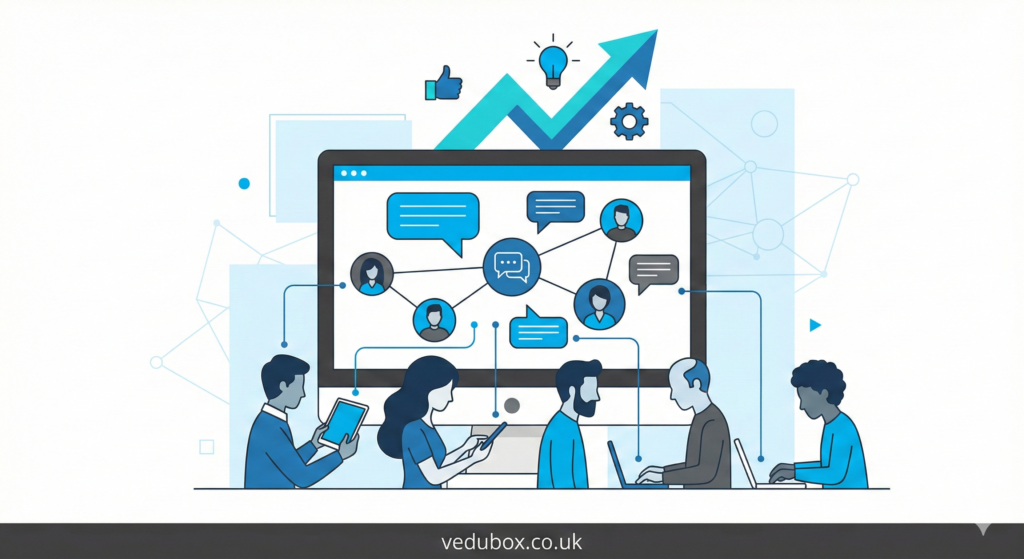
Forcing students to discuss complex topics in environments like social media groups or instant messenger group chats is an engagement killer. To boost learner participation, you need a dedicated, integrated space where the discussion happens right next to the related video or quiz.
Studies from platforms like Zenler and research in social learning confirm that courses featuring active, structured social communities often see 30-40% higher completion rates. The feeling of shared struggle and collective achievement is a powerful motivator.
Encouraging your learners to introduce themselves in a “Meet & Greet” topic or starting a “Weekly Wins” discussion where students celebrate even the smallest progress are simple but effective ways to drive engagement.
An LMS with integrated forum and newsfeed features keeps discussions, Q&As, and collaborative projects alive. When a student has a question, they stay on the platform and engage directly with their peer using the relevant content.
2. Gamification Is Not Juvenile
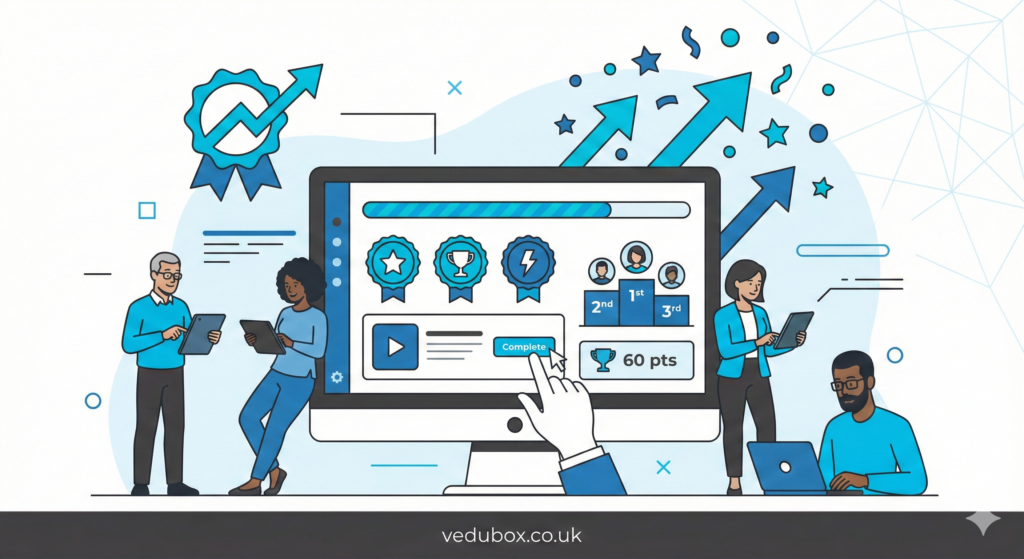
The psychology behind gamification in online learning taps into status, mastery, and achievement. When applied correctly, these elements drive progress and transform monotonous tasks into enjoyable challenges. Research suggests that incorporating gamification elements can significantly increase motivation and retention.
You don’t need complex systems. Start simple, like implementing a “Badges” system. Use a Leaderboard for cohort-based courses to promote healthy competition and social proof.
Built-in gamification tools in a comprehensive LMS allow you to automatically assign points, unlock badges, and update leaderboards based on student activity. So, you can focus on content creation while the system handles the students’ motivation.
3. Interactivity Breaks Monotony
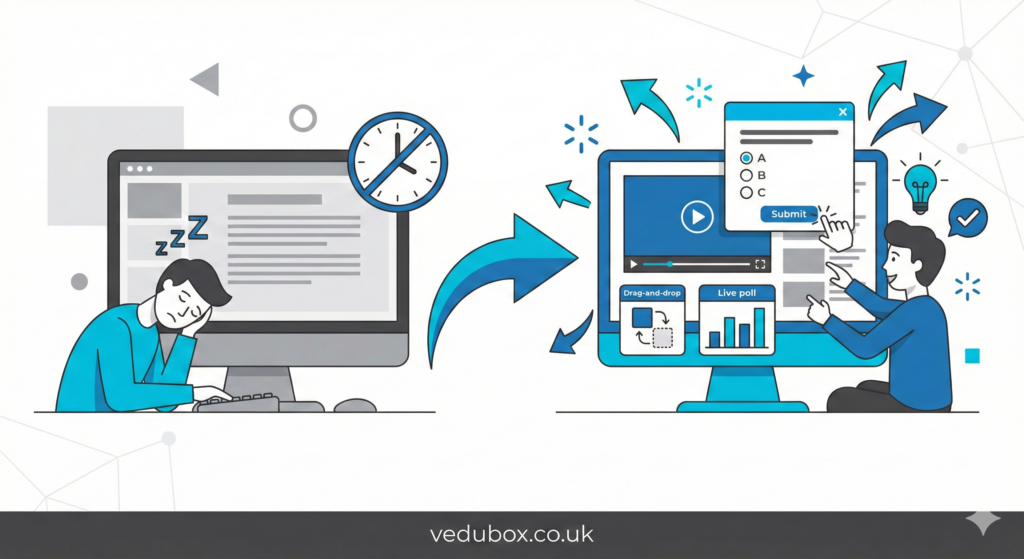
You risk your students ‘zone out’ when using passive, stable PowerPoint-like presentation slides. Interactive modules mimic natural engagement — they force the brain to actively process information rather than just absorb it.
Implement the ‘20-minute rule.’ Never design a content block that lasts longer than 20 minutes without a pattern interrupt.
You can use tools to reflect your students’ responses in real time on your slides and in your videos. To embed quizzes or polls directly into the video timeline, ensure your LMS supports SCORM. You can integrate high-level interactive content created with tools like Articulate or H5P.
4. Validate Even the Smallest Achievement
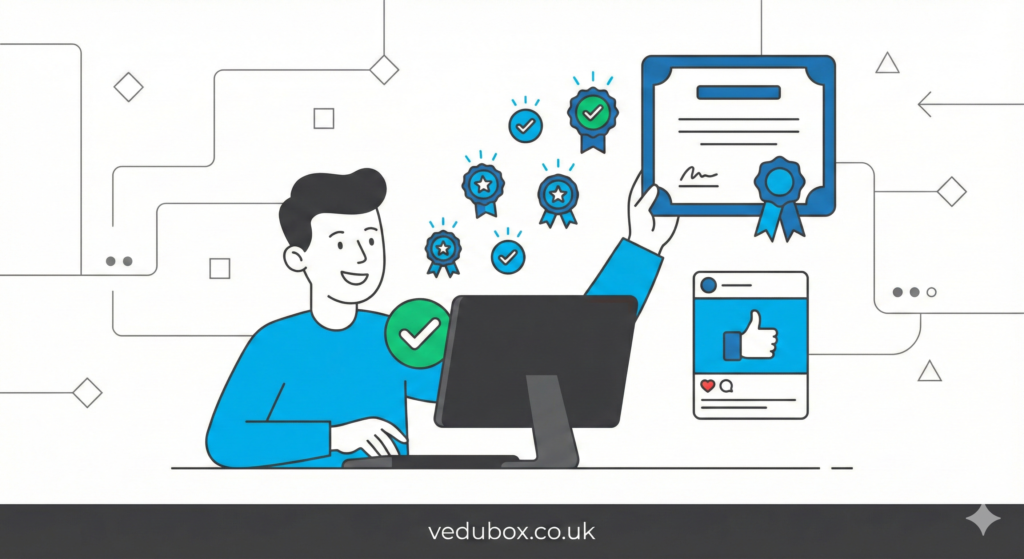
At the end of each module, preparing short quizzes to ensure that learners are on the right path helps more than a full-length test that covers the whole course. You can frame these short tests as ‘knowledge checks’ rather than high-pressure assessments. Additionally, a digital certificate for these accomplishments that students could share on their socials to ‘show off’ their achievements becomes a source of motivation.
Powerful LMSs include automated online exam and certification systems, of which you can set up grading, instant feedback, and certification processes. This automation eliminates manual labor and also proves that participants really learned something.
5. Don’t Lose the Human Touch
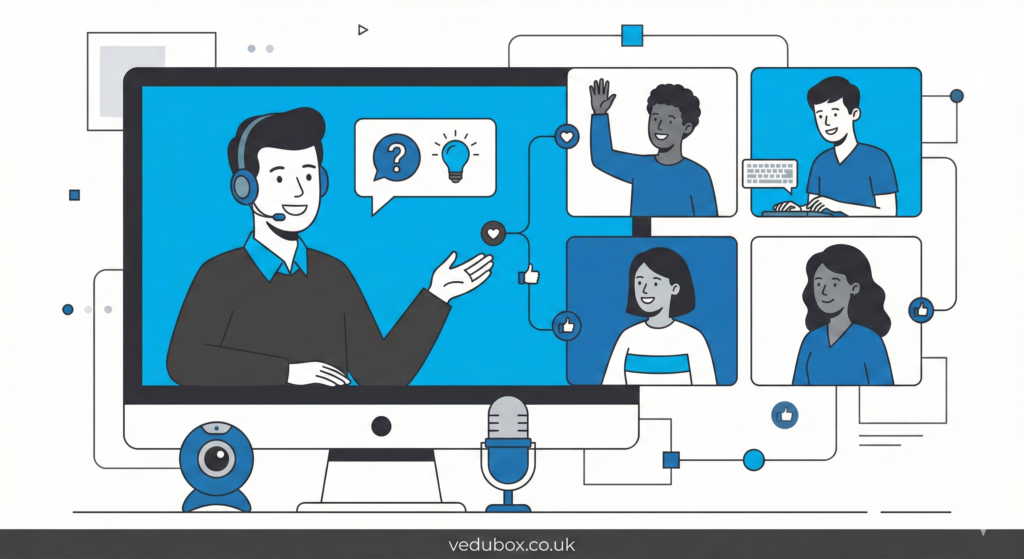
While pre-recorded content offers fantastic scalability, it often lacks the emotional connection required to sustain long-term commitment. Incorporating a ‘live’ element is a powerful learner engagement strategy that justifies a premium price point and builds deeper trust.
Host ‘office hours’ Q&A session specifically for premium students regularly. This real-time interaction strengthens bonds among you and your students, as well as among students themselves. Even if only 20% attend, the availability of the resource significantly boosts perceived value and accountability.
You can offer office hours with tools like Zoom and Google Meet integrated into your LMS, usually via the ‘live class’ feature. You can also organize webinars or 1-on-1s using this feature.
The Engine of a Profitable Training Business
If you are serious about scaling your online course business, mastering learner engagement is non-negotiable. It isn’t only a ‘nice to have’ because it drives customer lifetime value (CLV), reduces churn, and multiplies your passive income through powerful testimonials.
Book a free Vedubox demo, and we’ll guide you through scaling your business efficiently, while you focus on creating better teaching material — what you know best.