










The UK government’s AI Skills Hub is an ambitious initiative that aims upskill 10 million workers by 2030. The platform, partnered with tech leaders such as Google and Microsoft, offers a wide range of courses from basic AI literacy to advanced machine learning concepts.
A Necessary First Step with Good Intentions
Addressing the digital skills gap to support the UK’s economic growth and democratizing access to high-quality resources, the platform’s intentions are clear and commendable. It demonstrates that the government understands that it’s fundamental for the entire workforce to be AI-fluent.
The Platform Doesn’t Deliver What It Promises
However, the content is largely generic and functions as a manual for Big Tech tools rather than genuine skill-building. While the platform offers personalized pathways, the approach is mostly one-size-fits-all, which carries the risk of giving false confidence to L&D leaders.
Another problem with the platform is that it’s disjointed. It doesn’t host the content; it only acts as a hub that sends users to vendor sites, which creates login fatigue. Additionally, most of these vendors are US-based, so the platform is not quite “national.”
The biggest danger, however, is how the platform is promoted: “Free Government Training.” That’s simply a trap, and it makes L&D’s job to persuade the C-suite allocate budget to training and development. Unfortunately, AI Skills Hub, in its current state, is far from providing the tools to equip fundamental AI skills.
The Lesson Here Is “Context Is King”
L&Ds should be aware that access to a massive content library isn’t enough to build effective training and development strategies. Especially if that library consists of an abundance of external links that requires seperate login processes. You need a centralized system that supports identifying skills gaps and creating customized career paths for specific roles that comply with regulatory requirements.
Building a Strategic L&D Response
When building your internal AI strategy, avoid the “content dump” trap. Instead of directing staff to a generic portal, L&D leaders should curate learning paths that map specific AI tools to actual business problems.
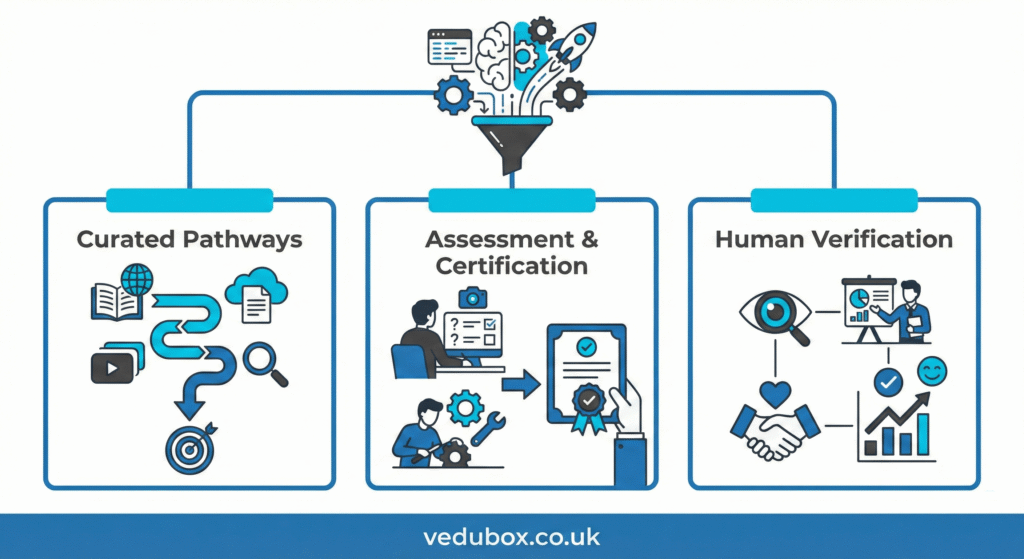
An all-in-one learning management system offers the infrastructure you need to design and execute an effective L&D strategy. Three main features that help you overcome the challenges of a disjointed system are curated pathways, assessment & certification, and human verification.
- Curated pathways allow mixing external sources with company-specific context.
- Assessments & certification help you verify that your team not only consumed content; you can measure learning through proctored exams or practical assessments, and issue certificates to successful candidates.
- Relying solely on completion rates is flawed. The human element should be there to track engagement and practical application.
You must remember that awareness and competency are not the same thing. You need quantifiable results; achieve your ROI goals and allocate them to training and development. Your workforce should leverage AI skills to improve decision-making, drive innovation, and increase productivity; knowledge alone is not enough.