





Corporate training has long been stuck in conference rooms once a year or quarterly, costing companies massive amounts. Worse yet, there was almost no proof that it worked.
While digitization in learning technologies has started to break this habit, the pandemic catalyzed the adoption of remote training. Hybrid working has become the norm, and remote working is desirable for most of the workforce; companies have had to transform to meet these demands. This transformation, of course, required a change in the corporations’ approach to training as well.
The old, event-based training became increasingly obsolete. Additionally, long hours of theoretical training and its impact became questionable. The pressure on L&Ds increased with each penny spent being scrutinized.
Training should be quick, accessible, practical, and have a measurable effect.
Agile Microlearning
To solve the problem of clunky, event-based training, many companies are now turning to microlearning. Instead of long, draining sessions, microlearning breaks information into small, easy-to-digest pieces. Training becomes part of the everyday routine, giving people the answers they need right when they need them.
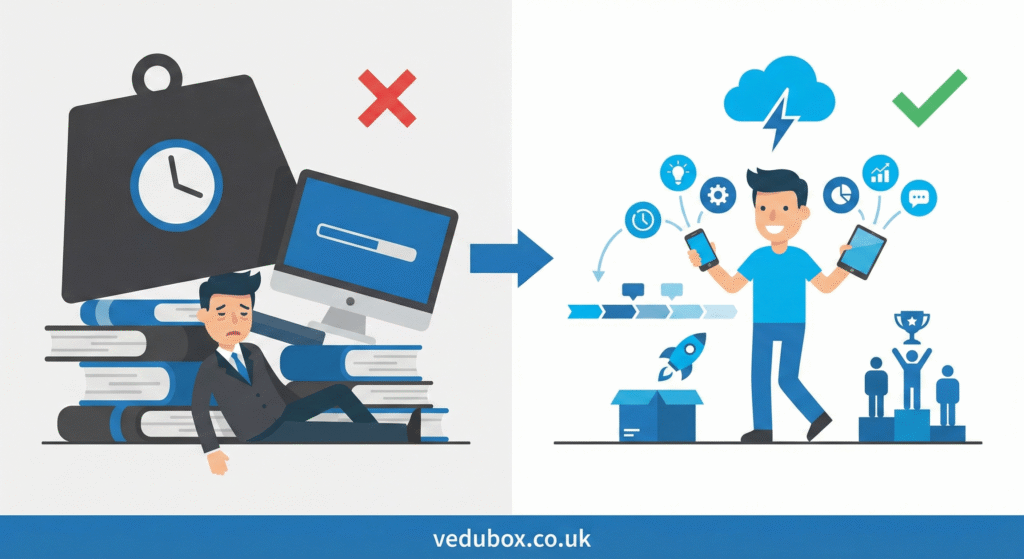
Microlearning is especially useful for sharing important updates, like new product features or how your company stacks up against the competition. Teams can pick up what they need in minutes, not hours. Instead of being a box-ticking exercise, training becomes a steady source of support that actually helps people do their jobs.
The Challenge of Execution
But moving to microlearning is not always easy. Many learning managers find themselves juggling a patchwork of different tools. One platform for videos, another for quizzes, and yet another for live sessions like Zoom or Google Meet. The result is a confusing experience for everyone involved.
Without a single, unified system, keeping track of progress is almost impossible. It is hard to know if someone has really finished a training module or just clicked through it. Linking training to real business results, like sales or customer satisfaction, is even harder when information is scattered across different platforms. The aim is to make learning something you can measure and build on, but using too many tools often means you lose sight of what is actually happening.
Overcoming Friction with an All-in-One Platform
The answer to these headaches is to bring everything together in one place. With a platform like Vedubox, companies can run live training, self-paced courses and assessments all from a single system.
Vedubox works smoothly with tools like Zoom and Meet, so live sessions can be organized and tracked without leaving the platform. This means companies can go beyond just ticking off who attended. Every interaction, whether it is a live webinar or a quick five-minute guide, is recorded and measured.
The 12 Pillars of a Systematic Knowledge Ecosystem
To build a resilient workforce, companies must move beyond ad-hoc training. An all-in-one system permits the systematic delivery of 12 critical “knowledge sets” that agile companies provide to their staff.
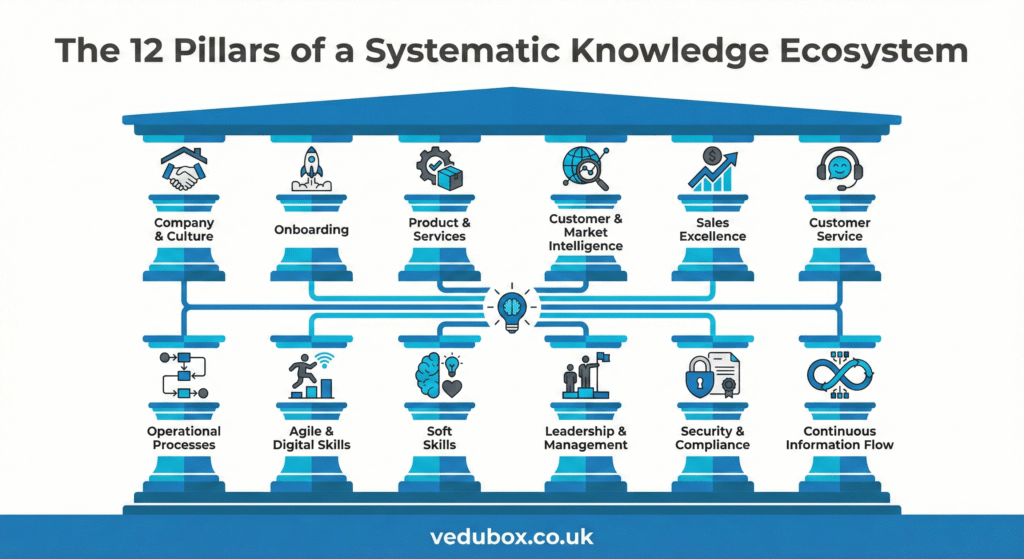
- Company & Culture: Covers vision, mission, and values to answer “Who are we?” This includes crucial internal communication procedures and hybrid working rules (in American English, ‘hybrid work guidelines’).
- Onboarding: A structured flow for the first 90 days, including tool introductions and role-specific responsibilities, facilitating fast adaptation.
- Product & Services: Constant micro-updates on features, benefits, and competitor comparisons to keep the team sharp.
- Customer & Market Intelligence: Defining target personas and customer journeys to create a shared commercial language across the business.
- Sales Excellence: Methodology, objection handling, and value propositions delivered via short, impactful videos.
- Customer Service: Training on empathy, crisis management, and escalation rules to defend brand reputation.
- Operational Processes: Department-specific workflows and documentation standards to guarantee efficiency.
- Agile & Digital Skills: Modern competencies like Scrum, Kanban, and data literacy to train the workforce for the future.
- Soft Skills: Personal development modules on communication, time management, and decision-making that boost performance regardless of role.
- Leadership & Management: Coaching, performance management, and OKR setting for current and aspiring leaders.
- Security & Compliance: Mandatory but streamlined training on GDPR (Data Privacy), cybersecurity, and information safety.
- Continuous Information Flow: A stream of “Did you know?” tips and weekly summaries to maintain a culture of constant learning.
Sharing these pillars through one system brings much-needed consistency. But what really sets Vedubox apart is its content market. This is more than just a library. It is a shared space where companies can find ready-made training, sales and compliance materials that have already been tried and tested by others. This market saves time and helps teams get started faster.
From Consumers to Creators
The real goal for any business should be to move from simply using training to actually creating value. Vedubox makes this possible by making it easy to build and share content consistently.
Clients can use built-in tools to make interactive videos, quizzes and assessments, or connect with professional tools like Articulate and Vyond. Even more, they can become part of the ecosystem as content creators. If a company builds a great sales training module, it can offer it on the marketplace, earning revenue and building its reputation.
With this all-in-one approach, companies can track every part of the learning journey, create detailed reports, and grow their training programs sustainably. In the end, training becomes more than just a cost. It turns into a valuable asset that helps the business succeed.