Contents
Almost every growing organization eventually hits a technological wall with its training programs. You look at your tangled web of spreadsheets, your disjointed video links, or your escalating SaaS bills and think, “How hard could it be just to build our own learning platform?”
It is an incredibly intoxicating thought. With the rise of “vibe coding” and AI copilots practically writing code for us, it’s tempting to feel like you could whip up a custom Learning Management System (LMS) over a long weekend.
You picture crafting a bespoke platform that perfectly mirrors your exact company workflows — an elegant piece of software without a single useless feature cluttering the dashboard. Plus, there’s the undeniable thrill of ghosting your software vendor and never paying a recurring “per-user” licensing fee ever again.
When you build, you hold the keys to the kingdom. You can design an API that perfectly shakes hands with your decade-old, heavily customized internal HR system. The software bends entirely to your will.
The Hidden Trapdoor of Custom Builds
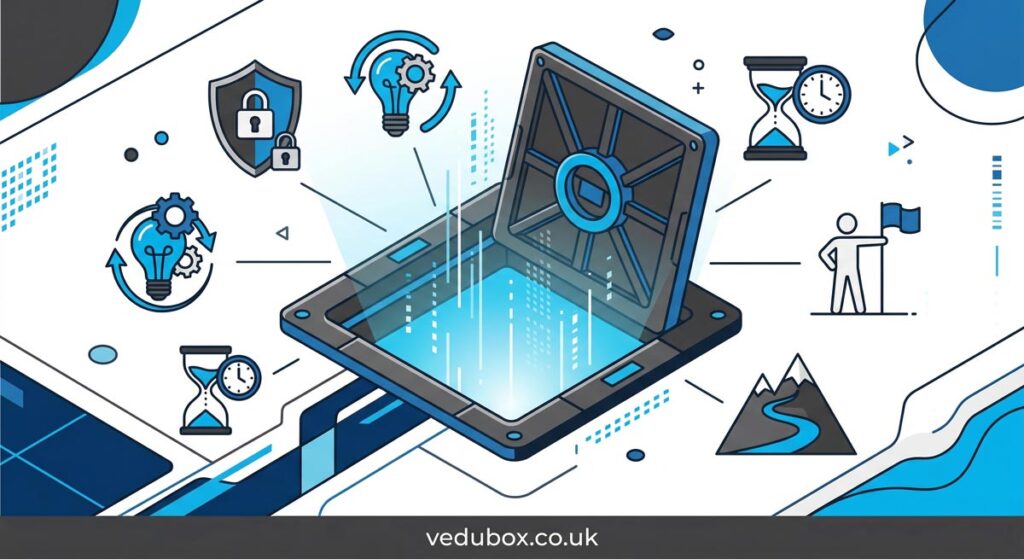
But then Monday rolls around, and the reality of software development bites back. As many engineering teams will quietly admit, building an LMS is less like assembling IKEA furniture and more like adopting a very demanding, high-maintenance pet.
Your MVP may work for 50 friendly testers. But by quarter’s end, when 5,000 employees log in to stream video and finish compliance training by 5 PM, your custom-built servers may struggle under the stress.
Then there is the alphabet soup of eLearning standards. Try asking your lead engineer to build a system from scratch that flawlessly tracks, resumes, and reports on complex SCORM files. You will quickly learn that “SCORM” is practically a five-letter word in developer circles.
Add in the relentless, unglamorous demands of patching security vulnerabilities, maintaining GDPR privacy compliance, and ensuring WCAG accessibility standards, and suddenly your fun internal project is eating up tens of thousands of dollars a year just to keep the lights on.
The highest hidden cost is opportunity. Every hour your top engineers reinvent video hosting or fix quiz modules is an hour not spent on your core product.
When Does Building Actually Make Sense?
Now, we’re not saying you should never build. If your training methodology relies on highly proprietary technology that simply doesn’t exist on the open market, grab your hard hat. Or, if your learner base is the size of a small country and standard SaaS seat fees would literally require a second mortgage, a custom build makes financial sense. It’s also the right move if your core business is selling LMS software (in which case, hello competitor!).
If you fit that highly specific profile but try to force an off-the-shelf solution to work, you will be miserable. You’ll find yourself shoving square pegs into round holes, frustrated by rigid templates that look like they were designed during the dial-up era, and fighting a vendor lock-in that makes migrating your data out feel like a hostage negotiation.
The Financial Reality
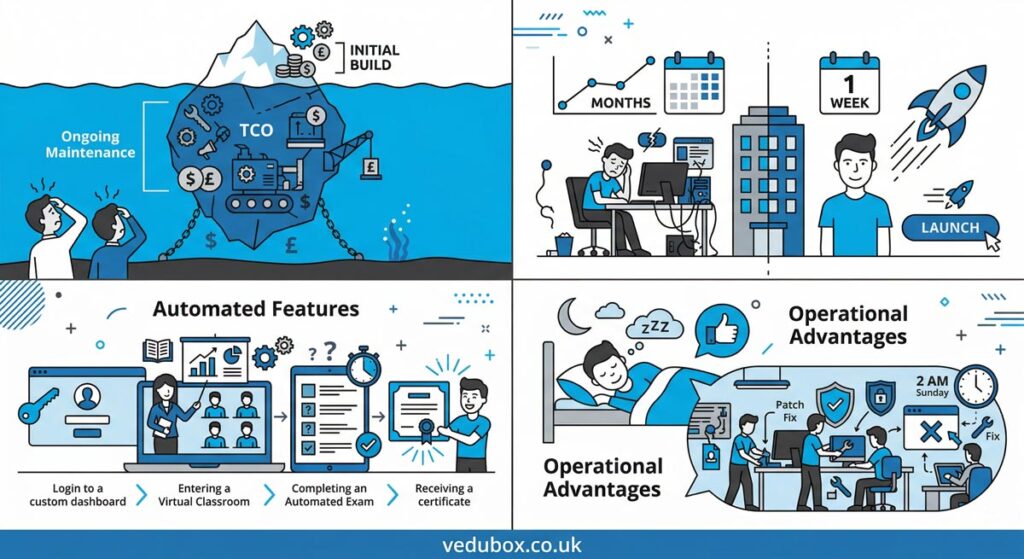
But let’s look at the financial and operational reality for the vast majority of organizations. Total Cost of Ownership studies are pretty sobering. As industry research consistently shows, the initial build is just the tip of the iceberg.
Buying a modern SaaS platform, on the other hand, costs a fraction of the maintenance alone. And the operational advantages are night-and-day.
Instead of waiting months for an internal team, you could buy a platform and launch in a week. New hires or customers can log into a white-labeled dashboard, enter a virtual classroom, complete an automated exam, and receive their certificate right away.
And when a critical browser update breaks a feature or a security patch needs to be deployed at 2:00 AM on a Sunday? The vendor’s engineering team handles it while you sleep peacefully.
Get the Best of Both Worlds
If your goal is training impact rather than tech management, buying wins. Choosing a modern platform lets you focus on learners without getting sidetracked by infrastructure or maintenance.
But you don’t have to settle for clunky legacy software to get those benefits. Vedubox is an All-in-One eLearning Platform designed to give you enterprise-level scalability without the engineering challenges. It’s a unified ecosystem with a powerful LMS, Virtual Classrooms, Online Exam Systems, and eCommerce capabilities built right in and ready to go.
Book a Vedubox demo today, and let us show you what a stress-free training environment looks like.
Bring all your training together on one platform.
Manage your training, exams and reporting from a single place with Vedubox.
Request a Demo


.svg)