Contents

Extraordinary to watch, spinning suspended weightless in the crisp mountain air, a champion free skier is a marvel of physical resilience and mental determination. But the true alchemy happens beneath the helmet. During the 2026 Winter Olympics, a journalist asked Eileen Gu an unusually direct question: “Do you think before you speak? […] Can you take us into your brain?”
Let’s remember how she responded.
The Alchemy of the Mind
Her response was a striking articulation of self-mastery: “You can control what you think. You can control how you think, and therefore, you can control who you are.”
It is a profound realization. (Because let’s be honest, if you ask most of us to take you into our brains, the tour mostly features a mental grocery list and a song stuck on a loop since 2014). But Gu’s approach offers a powerful blueprint for educational institutes and independent course instructors. By observing her mindset, we can uncover vital insights into metacognition in education.
Neuroplasticity and the Architect of the Self
Like the ancient, ever-shifting landscapes of the world, our minds are not static. They are biologically designed to adapt. Gu touches on this explicitly during her interview: “And especially as a young person, I’m 22, so with neuroplasticity on my side, I can literally become exactly who I want to be.”
Science backs her up entirely. As noted in The Conversation, “Once believed to occur only during early development, research now shows that plasticity continues throughout the lifespan, supporting learning, memory, and recovery from injury or disease.”
This biological reality is the foundation of metacognition in learning. Gu breaks down her own introspective method perfectly: “I journal a lot. I break down all of my thought processes. I think I apply a very analytical lens to my own thinking, and I modify it because it’s so interesting.”
She describes treating her mind “in a tinkering, like a scientist way.” This conscious, deliberate auditing of one’s own thought process — asking, “how can I be better?” — is exactly what modern instructors strive to cultivate in their students.
Metacognition Teaching Strategies
So, how do we systematically build this “tinkering” mindset in our learners?
According to the MIT Teaching + Learning Lab, “Metacognition is the process by which learners use knowledge of the task at hand, knowledge of learning strategies, and knowledge of themselves to plan their learning, monitor their progress towards a learning goal, and then evaluate the outcome.”
Applying metacognition strategies in the classroom involves a delicate balance of guidance and independence. MIT suggests direct, actionable methods, including:
- “Encouraging students to journal or write a letter to their future selves.”
- Providing “an explicit list of prompts about planning, monitoring, and evaluating can help students better regulate their learning.”
These metacognition strategies sound brilliant in theory. But practically? Implementation is often a place of stark contrasts: the quiet dignity of a student reaching a breakthrough against the fuss and administrative chaos of managing it all.
The Analog Nightmare
Trying to scale these strategies across hundreds of students without a centralized system is a logistical labyrinth. Imagine collecting, reading, and organizing hundreds of handwritten journals, pre-assessments, and reflection wrappers. Unless you have a team of highly caffeinated scribes at your disposal, the manual effort will quickly crush your instructional goals.
Without digital infrastructure, the sheer volume of qualitative data makes it impossible to monitor progress effectively or provide the timely feedback necessary to spark real cognitive change.
Sculpting the Mind with Vedubox
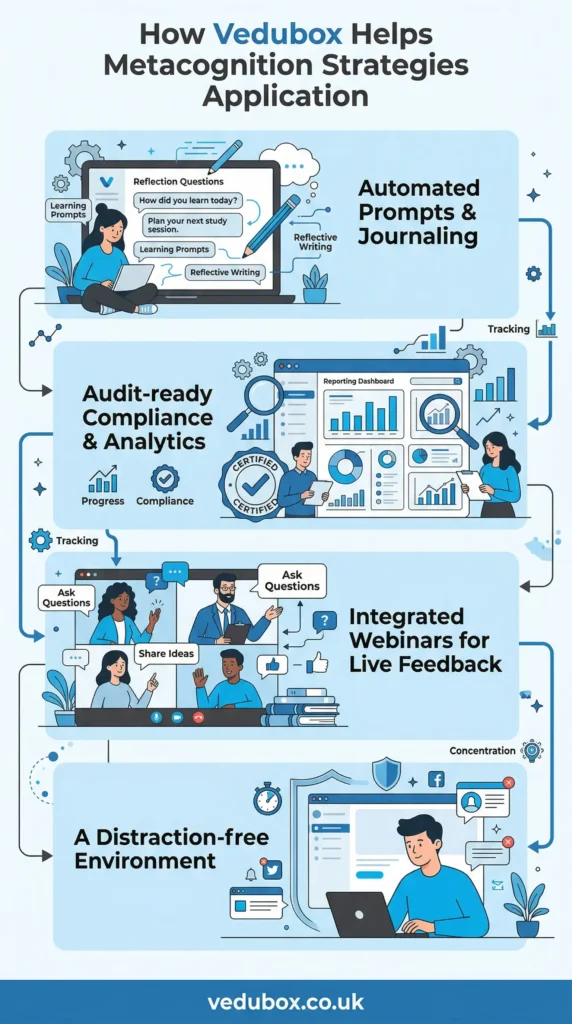
Here is where a collaborative integrated learning platform makes a difference. With Vedubox, educational institutes can embed metacognition teaching strategies directly into the digital fabric of their courses, turning abstract theory into auditable practice.
- Automated Prompts & Journaling: Utilizing Vedubox’s online exam and survey modules, you can schedule pre- and post-lesson reflections. Instructors can prompt learners to ‘break down their thought processes’ just as Gu does, capturing these insights digitally.
- Audit-ready Compliance & Analytics: Vedubox’s advanced reporting provides detailed learner engagement metrics. You have the data and the auditable trails to prove your teaching methods work. Or you can easily spot where you must improve.
- Integrated Webinars for Live Feedback: Metacognition thrives on dialogue. With integrated video conferencing, instructors can hold real-time feedback sessions, guiding students to view their learning through an analytical lens.
- A Distraction-free Environment: By utilizing clean, corporate identity-aligned interfaces, Vedubox ensures the cognitive load is spent on learning, not navigating clunky software.
The Ultimate Flex
The benefits of embedding these tactics into your curriculum are massive. Students who actively monitor and modify their learning strategies go beyond memorizing data; they adapt. They become resilient, independent problem solvers capable of navigating complex challenges. They get to experience what Gu joyfully calls “the biggest flex of all time” — having their younger selves be proud of the thinkers they have become today.
You cannot force a student to learn, but you can provide the ultimate environment for them to tinker, modify, and grow. Equip your institution with the most powerful and flexible tools for online courses, training, and evaluations.
Book a Vedubox today, and let’s turn your learning platform into a metacognitive powerhouse.

Bring all your training together on one platform.
Manage your training, exams and reporting from a single place with Vedubox.
Request a Demo



.svg)