Contents
According to the highly authoritative 2024 Annual Work Trend Index by Microsoft and LinkedIn, 75% of global knowledge workers use AI at work today. Yet, paradoxically, the same report notes that 59% of executives worry they lack the AI skills needed to implement AI strategies successfully.
Whether you are hiring a marketing director, a logistics coordinator, or a healthcare administrator, AI proficiency is as basic as knowing how to use email. But there is a massive difference between a professional who strategically delegates to AI and someone who treats it like an infallible, magic 8-ball.
People are using the tools, but very few are using them well.
Measuring effective and efficient use of AI tools has become critical in talent acquisition and upskilling the current workforce.
The 5-Pillar AI Competency Framework
You can’t just hand a candidate a keyboard and say, “Do some AI.” You need a structured evaluation system. When assessing AI proficiency, you are looking for five distinct competencies.
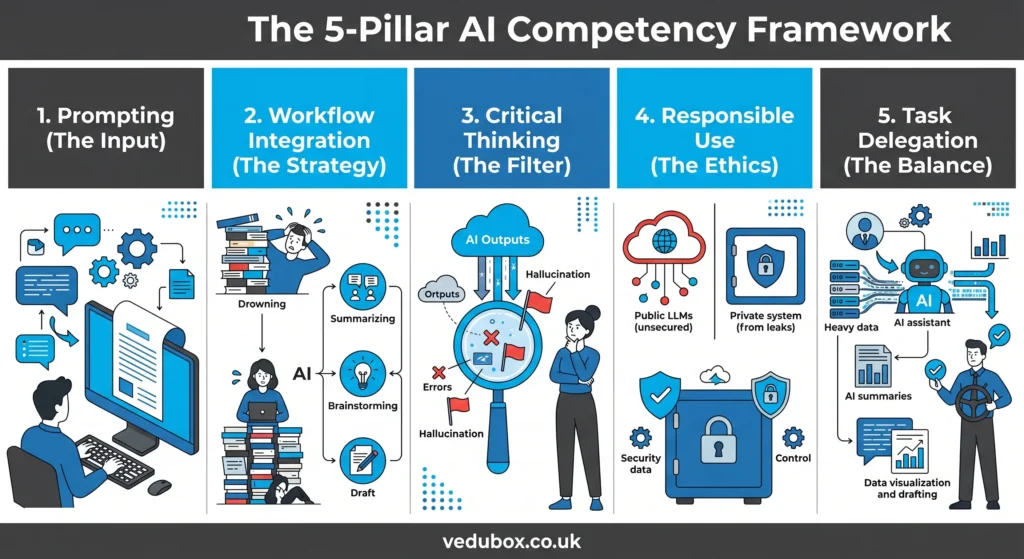
1. Prompting (The Input)
Prompting is related to effective communication skills. Asking an LLM to perform a task is like briefing an agency. Providing clear, context-rich instructions is key to the most desirable result. Otherwise, you might get stuck in a revision loop and end up getting nothing done in time.
2. Workflow Integration (The Strategy)
Not every task requires AI intervention. An employee with high AI proficiency knows which tasks to automate with AI. They facilitate summarizing meeting transcripts, brainstorming, and drafting rather than creating final products.
3. Critical Thinking (The Filter)
In a study by the IBM Institute for Business Value, researchers found that 4 in 5 executives say generative AI will change employee roles and skills, with critical thinking emerging as the top required skill. Even the most advanced LLMs hallucinate. So, critical thinking becomes increasingly important to evaluate AI-generated outputs.
4. Responsible Use (The Ethics)
Using public LLMs for business risks the provision of confidential information and data about the company and its clients. Understanding the difference between enterprise-secured AI and public-facing models is important.
5. Task Delegation (The Balance)
A proficient AI user doesn’t outsource their taste, empathy, or final strategic judgment. They delegate the heavy lifting of data synthesis and drafting, while retaining ownership of the final product.
7 Tools to Assess AI Competency
So, how do we actually test these pillars? You don’t have to build a test from scratch. The HRtech sector has been working overtime, and there are currently several platforms designed to evaluate practical AI skills safely and effectively.
- Bryq: Bryq offers a brilliant, tool-agnostic assessment that specifically measures practical AI proficiency, with a heavy focus on ethical use and the critical evaluation of AI outputs.
- AISA: A highly specialized tool perfect for diagnosing current capabilities. What we love about AISA is that it doesn’t just score you; it suggests immediate, targeted training pathways based on where the candidate failed.
- Cicero Assessment (CGS Immersive): If you are in a highly regulated sector like Medical or Insurance, this is gold. It grades live conversations and delivers highly detailed, audit-ready records of candidate competency.
- iMocha: Famous for their “AI-LogicBox,” iMocha allows you to evaluate real-world job readiness across functional skills rather than just multiple-choice trivia.
- Vervoe: Vervoe uses machine learning to drop candidates into immersive, real-world job simulations. You get to see how they actually behave in an AI-augmented environment.
- HireVue: By blending conversational AI and game-based assessments, HireVue measures a candidate’s cognitive adaptability—which is exactly what you need when the AI tools update every Tuesday.
- CodeSignal: While traditionally for software engineers, they are pioneering foundational AI task inputs and outputs for broader, non-technical roles, which is perfect for assessing marketers and operations managers.
Turning Assessments into Action Plans
Assessments only point out the gaps. They don’t fill them. Let’s say you run your current marketing team through Bryq, and you discover that 60% of them have absolutely no idea how to use AI responsibly. They failed the “Critical Thinking” and “Responsible Use” pillars spectacularly.
Now what? You can’t fire 60% of your staff. You have to train them. And you have to do it quickly, securely, and comprehensively.
This is where Vedubox steps in as your operational safety net.
As a global Collaborative Integrated Learning Platform, Vedubox is built specifically for B2B enterprises that need to turn assessment data into immediate, trackable upskilling.
- Audit-Ready Compliance & Reporting: Did an employee complete their “Responsible AI Data Privacy” training? Vedubox’s robust reporting tracks every minute of engagement. You can automatically issue certifications upon completion, meaning if auditors ever come knocking, your compliance trail is flawless and fully documented.
- Integrated Live Classes & Webinars: Don’t just hand them a PDF. Use Vedubox’s integrated video conferencing to host live, interactive AI upskilling workshops led by your internal experts. Record the session, and immediately drop it into your…
- Video Class Library: Build an evergreen internal repository of “How-To” AI guides specific to your company’s sector. Whether it’s “Prompting for Aviation Logistics” or “AI in Healthcare Administration,” your team has 24/7 access to secure, proprietary training materials.
Testing AI proficiency is the crucial first step to protecting your company from the self-proclaimed AI specialists of the world. But teaching AI proficiency is how you actually win the market.
Don’t let your workforce fall behind the algorithm. Assess their baseline, and then plug them into a learning platform that scales with their ambition.
Book a demo to see how Vedubox’s Integrated Learning Platform can transform your corporate training today.
Bring all your training together on one platform.
Manage your training, exams and reporting from a single place with Vedubox.
Request a Demo


.svg)