Contents
If you think that a PDF sent via email about regulatory compliance to your employees during their onboarding or their attendance at an annual training workshop would satisfy auditors from authoritative bodies, think again.
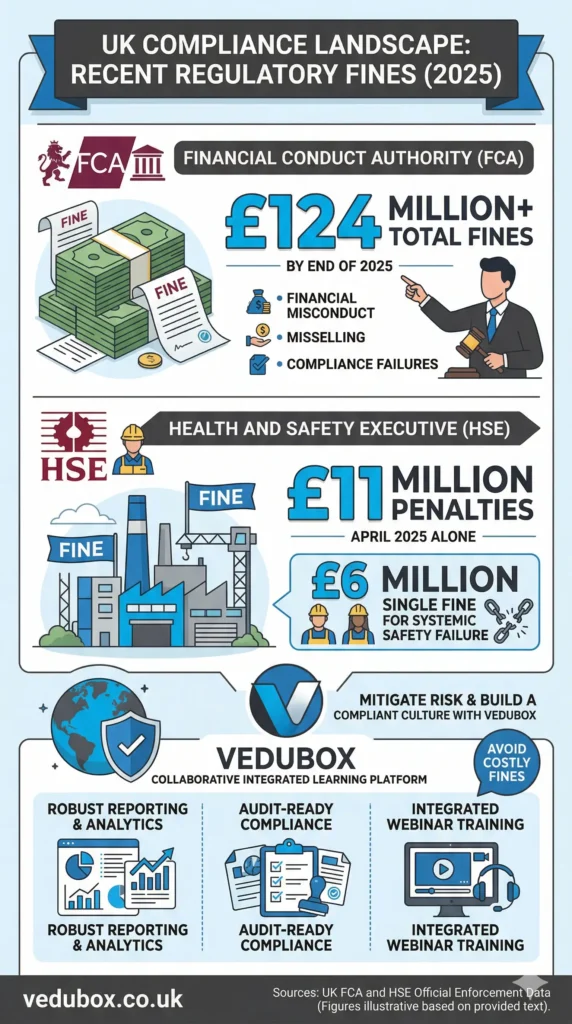
According to enforcement records, the UK’s Financial Conduct Authority (FCA) levied fines totaling over £124 million by the end of 2025. Meanwhile, the Health and Safety Executive (HSE) issued penalties totaling £11 million in April 2025 alone, including a £6 million fine for systemic safety failure.
What is remote work in the eyes of a regulator? It is no longer just a flexible HR perk; under the Employment Rights Act 2025, it is a heavily protected statutory right. More importantly, it is a massive expansion of your corporate liability footprint straight into your employees’ living rooms.
Tracking Competency
Developing and executing Learning and Development (L&D) strategies for geographically dispersed teams is a bit like herding cats — only with severe legal and operational ramifications. Industry data from several studies show that approximately 40% of the UK workforce operates either remotely or in a hybrid setup.
The primary challenge is tracking remote work compliance and providing concrete evidence during an audit.
Historically, organizations relied on a simple training matrix. Today, the Care Quality Commission (CQC) demands evidence that training has translated directly into applied clinical skills. If a remote care worker has watched a safeguarding video but cannot accurately articulate internal reporting procedures to an inspector, the provider faces a severe Regulation 18 breach.
Similarly, the FCA mandates that appropriate governance and oversight by senior managers must be maintained regardless of physical location. Tracking this complex web of regulatory adherence via manual spreadsheets is not just outdated — it is actively dangerous.
Moving from Completion to Continuous Validation
To protect your organization, you must rethink compliance training as a continuous, technology-driven governance strategy. Effectively managing remote compliance requires adopting a proactive stance.
- Active Competency Validation: Transitioning from passive video delivery to scenario-based assessments to prove skill retention.
- Secure Synchronous Environments: Utilizing locked-down digital spaces for sensitive training to prevent the use of unmonitored off-channel communications.
Automated Audit Trails: Generating real-time dashboards that instantly flag non-compliance and provide timestamps of digital confirmations.
What You Need Before Applying the Solutions
You must lay the foundations for efficient training and compliance tracking before application and execution.
The first requirement is a unified cloud architecture. Your employees must be able to access mandatory training modules from anywhere, at any time.
Second is data centralization, and it is non-negotiable. You cannot prove oversight if you store HR files, exam scores, and live-training logs in different locations.
Finally, leadership must commit culturally to integrating compliance into daily digital workflows, reinforcing corporate expectations in the digital environment.
The ‘Franken-stack’ Dilemma
If the solution is clear, why are so many enterprises failing audits? The answer lies in software bloat. In a frantic bid to digitize, organizations patch together a ‘Franken-stack’ of tools: a standalone LMS, an external video conferencing app, a third-party exam proctor, and a disconnected eCommerce portal.
This approach is catastrophic. Organizations using disparate, disconnected tools suffer from significant administrative redundancies, data silos, and an inability to measure the return on these substantial investments accurately.
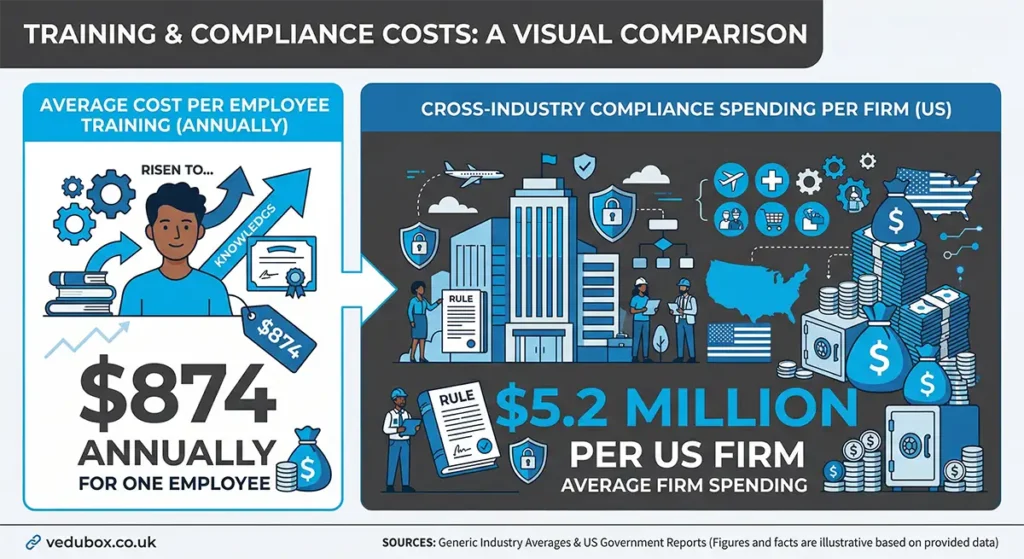
The average cost to train an employee has risen to $874 annually, while cross-industry compliance spending averages $5.2 million per firm in the US. Trying to integrate these disconnected tools is technically complex and leaves L&D directors spending their days acting as IT support rather than strategic leaders.
The Antidote to Compliance Chaos
You don’t need more software; you need smarter software. Vedubox is a definitive technological solution for distributed workforce compliance, replacing disjointed applications with an all-in-one, AI-powered ecosystem. By centralizing these functionalities into a single platform, organizations immediately eliminate software subscription bloat and unify their data.
Features Engineered for Unshakable Compliance
Vedubox is your partner in delivering comprehensive, audit-proof compliance training. Here is how its native architecture directly addresses the pain points of the distributed paradigm.
- The LMS Engine (Automated Reporting): Vedubox automates the distribution of mandatory modules directly to remote dashboards. When an HSE inspector demands proof of proactive risk management, you can pull out a report demonstrating details about training completion, assessment scores, and the verifiable timestamps.
- Virtual Classrooms: To combat the severe regulatory risks of off-channel communications, Vedubox provides highly secure Virtual Classrooms for all internal training. You can securely host, record, and archive all communications in compliance with your region’s regulatory body’s record-keeping mandates.
- Online Exam Systems: Vedubox moves beyond tracking video views by deploying comprehensive, scenario-based assessments via randomized question banks and timed environments. The platform’s automated certification feature then instantly generates verifiable credentials, creating an audit-ready digital portfolio for every employee.
- eCommerce Integration: Healthcare organizations frequently rely on high-turnover agency staff who must also meet strict standards. Vedubox’s integrated eCommerce module enables providers to securely distribute or sell accredited compliance courses to their extended enterprise networks.
Integrated educational technology is the ultimate safeguard of both corporate integrity and commercial success. Relying on fragmented software and manual oversight risks regulatory fines and diminished margins.
By correlating training engagement metrics with reduced incident reports and the avoidance of regulatory penalties, L&D leaders can empirically demonstrate that advanced compliance technology directly protects the bottom line.
It’s not worth losing sleep — and profits — over an unexpected audit. Book a Vedubox demo and let’s discuss how we can help you transform your compliance strategy into a competitive advantage.

Bring all your training together on one platform.
Manage your training, exams and reporting from a single place with Vedubox.
Request a Demo


.svg)